
 Best Platforms
 Live Odds








9 Michigan Senate Candidate Signals Worth Knowing in 2026
A case-study guide to reading the Michigan Senate field in 2026 without overreacting to headlines—use coalition mapping, money quality, ground-game signals, issue ownership, and biography coherence to separate momentum from noise.
In a Senate race, the loudest moment isn’t always the most important one. A viral clip, a single endorsement, or one big fundraising report can pull your attention away from the slower signals that actually shape a campaign’s ceiling and floor.
This case study gives you a practical way to evaluate Michigan’s 2026 contenders as the cycle unfolds. You’ll learn which signals tend to predict staying power, how to spot common misreads, and what to track week-to-week so you can compare candidates on the same scoreboard.
Why these signals
Michigan’s 2026 Senate race will run through a crowded primary, heavy outside spending, and nonstop national narratives. In that environment, candidate “signals” give you faster viability checks than partisan headlines.
Real 2024-25 shifts
A lot moved under Michigan politics since the last cycle, and it changed what voters reward. Issue cross-pressures got sharper, and trust in institutions stayed fragile.
Abortion politics stayed salient, but it also sorted candidates by credibility.
Manufacturing and trade talk got more local and more workforce-specific.
Gaza and Ukraine created intra-party splits, especially among activists and donors.
Lansing trust remained a live wire, pushing outsiders and “fix it” brands.
When the electorate is cross-pressured, signals show who can hold a coalition together.
How to read signals
Treat signals as evidence, not vibes, and sort them into three buckets. You’re trying to see coalition, competence, and electability without guessing motives.
- Label the signal: coalition, competence, or electability.
- Ask what action created it, not who amplified it.
- Check if it repeats across weeks, not one news cycle.
- Verify with primary sources: filings, transcripts, official calendars.
- Note what it costs: time, money, risk, or relationships.
If it’s cheap to create and easy to fake, discount it hard.
Common misreads
Most bad takes come from mistaking visibility for strength. These three errors show up every cycle.
- Treating endorsements as votes already banked.
- Equating online reach with turnout operations.
- Assuming fundraising equals persuasion capacity.
A signal only matters if it converts to votes under Michigan’s actual rules.
What to track weekly
A simple weekly routine keeps you grounded when the news gets loud. You’re watching for accumulation, not viral moments.
- Scan new filings, amendments, and committee structures.
- Log local news hits, especially regional outlets and unions.
- Track field events: doors, town halls, faith, campus, VFW halls.
- Compare messaging across audiences for contradictions or discipline.
- Save receipts: links, screenshots, and dates for trendlines.
Do this for a month and you’ll spot the serious campaigns early.
Signal 1: Coalition map
A Michigan Senate candidate has to sound consistent in Detroit, the suburbs, and small-town communities. You’re watching for one voice that adapts, not three personas that rotate.
Base plus expansion
A real coalition starts with the base, then shows receipts of outreach beyond it. You’re looking for contact that creates mutual obligation, not drive-by appearances.
The clearest tells are practical:
- They accept invitations from non-base groups.
- Those groups actually show up, then re-invite them.
- Their language fits multiple regions without code-switching.
- They can praise one place without insulting another.
If the “expansion” never happens on camera or in rooms that matter, it’s just a press release.
Surrogate diversity
Surrogates are the coalition made visible. You want validators who can vouch for competence across daily life, not just ideology.
Look for a mix like this:
- Labor leaders who share specific stakes.
- Business operators who talk execution.
- Faith leaders who emphasize service, not outrage.
- Veterans who discuss readiness and responsibility.
- Educators who focus on outcomes and systems.
If every surrogate comes from one lane, the campaign will govern from one lane too.
Regional authenticity
Michigan voters can hear when a candidate is reading a regional script. Authenticity is accuracy, comfort, and memory.
They name issues the way locals name them, and they reference local leaders correctly. They also show ties that predate the campaign, without begging for approval.
When they sound local everywhere, they’re ready to be statewide.
Warning signs
Coalitions break when messaging turns into costume changes. The fastest way to spot it is to compare speeches across regions.
Watch for these red flags:
- A different personality in each market.
- Culture-war bait used in one region only.
- Constant attacks on potential general-election allies.
- Praise for “unity” paired with purity tests.
If they’re burning bridges during the primary, they’re telling you how they’ll lose the middle later.
Signal 2: Money quality
Big totals are loud, but money quality is predictive. You want fundraising that signals durable support and spending that matches a Michigan win path.
Source mix
Donor mix tells you how a campaign is building power. Geography and donor type often matter more than the headline number.
Look for “earned” money signals:
- In-state donors showing local relevance and relationships.
- Repeat donors signaling satisfaction, not curiosity.
- A broad small-dollar base that keeps giving after news cycles.
- Institutional donors that match the candidate’s lane and coalition.
A huge out-of-state spike can be real. It can also be a moment, not a model.
If the money only travels in from far away, the votes may not show up either.
Spending discipline
Early spending shows whether the team can scale without melting down. You’re hunting for capacity-building, not vanity.
- Keep payroll lean until roles are clear.
- Limit consultant stacks and overlapping scopes.
- Fund compliance and reporting before “big splash” media.
- Buy data, tools, and training that compound.
- Invest in field hiring tied to a turnout plan.
A campaign that can say “no” early can usually say “win” later.

Outside group gravity
Outside groups engaging can validate a candidate’s viability. It can also reshape the campaign’s incentives.
Pay attention to three tells:
- Message alignment that stays consistent across entities.
- Legal separation that still avoids obvious coordination traps.
- Funding concentration that creates a single-point-of-failure.
When one sponsor becomes the campaign’s shadow, strategy starts serving the sponsor, not the electorate. (For recent context on outside money entering Michigan’s Senate race, watch how super PAC activity can change the incentives and the story.)
Lessons learned
A common failure pattern is simple. The campaign raises big, then spends like the race is already won.
Watch for mismatches that erode trust:
- Early TV or digital buys without a turnout machine.
- Constant creative resets that suggest no message discipline.
- Vendor churn that looks like panic, not optimization.
- Burn rates that force desperate fundraising later.
Money is only an asset when it buys confidence, capacity, and a repeatable plan.
Signal 3: Ground game
Ground game is proof the campaign can find voters, talk to them, and get them to actually vote. In Michigan, that means fitting into local media habits and community networks, not just buying statewide ads.
Field footprint
You’re looking for evidence of durable organizing, not a traveling photo op. The real signal is local structure that survives bad news cycles.
- Field offices in distinct regions, not one HQ
- Named precinct captains with clear turf
- Public canvass goals with regular updates
- Partnerships with churches, campuses, nonprofits
- Consistent local events beyond “bus tours”
If the footprint looks like a map, not a schedule, the operation is real.
Union and community ties
Union and community relationships show whether the campaign can move people, not just win a headline. You’re reading for integration: shared plans, shared lists, shared accountability.
A stronger signal than an endorsement is visible joint work. Look for labor and community leaders hosting trainings, turning out members, and coordinating messaging in their own channels.
If you only see podium photos, you’re seeing access, not capacity.
Volunteer energy test
Volunteer energy is easy to fake for one rally. The test is whether the campaign turns excitement into repeatable persuasion.
- Check if events are staffed with clear roles.
- Ask how fast new volunteers get a follow-up.
- Look for regular training, not one kickoff call.
- See whether volunteers canvass, call, and text.
- Notice if shifts target persuadables, not only supporters.
When volunteers persuade strangers, you’re watching turnout get built in real time.
What didn’t work
Campaigns fail in Michigan when they build field too late and try to “make it up” online. Another common miss is skipping rural persuasion, then acting surprised by margins.
You can often see it publicly: sudden hiring sprees, frantic event stacking, and messaging that never adapts by region. You’ll also hear constant talk about “momentum” while doors and phones stay quiet.
When the field build is reactive, the vote chase becomes reactive too.
Signal 4: Issue ownership
Issue ownership is when a candidate has a few Michigan-shaped issues they can explain, defend, and prioritize under pressure. You’re looking for repeatable commitments, not a rotating set of talking points. Under hostile questioning, real owners get clearer, not louder.
Top-three agenda
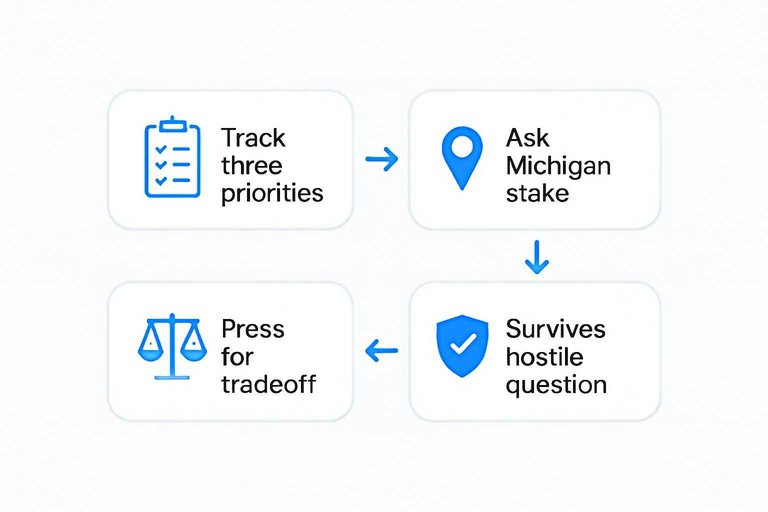
A coherent agenda is usually small on purpose. Three priorities force tradeoffs, which is where seriousness shows.
- Track three priorities across speeches, ads, and interviews.
- Ask what Michigan-specific stake each priority addresses.
- Press for a tradeoff they accept to pursue each priority.
- Listen for the same phrasing across different audiences.
- Check if the agenda survives a hostile question unchanged.
If they can’t keep three priorities intact, they won’t keep a coalition intact either.
Proof of work
Issue owners leave receipts. They can point to work that existed before the campaign and holds up to scrutiny.
- Sponsored or advanced relevant legislation.
- Delivered executive outcomes with clear accountability.
- Led or argued major litigation with consistent reasoning.
- Built organizing wins with durable local partners.
- Demonstrated policy fluency in tough interviews.
When the record precedes the ambition, the agenda is usually real.
Handling wedge issues
Wedge issues punish vagueness and reward discipline. You want clarity that doesn’t read as contempt for the other side.
Listen for three moves: a direct position, a human frame, and a boundary. Direct means they answer the actual question. Human means they can describe why reasonable people disagree. Boundary means they name what they won’t do, even if it’s popular in the moment.
Most “gaffes” are just unprepared tradeoffs said out loud. For context on how abortion shaped voter priorities post-Dobbs, see this KFF/AP VoteCast analysis.
Adaptation over time
Candidates can change, and sometimes they should. The test is whether the change is explained like a governing decision, not a polling response.
Check the timeline against public statements, votes, endorsements, and past interviews. Then look for an explanation that names what they learned, what evidence moved them, and what they still believe. If the new position keeps their underlying values intact, it’s evolution. If it rewrites their old claims, it’s opportunism.
Your best tool is simple: ask them to steelman their previous view before defending the new one.
Signal 5: Candidate biography
A Senate bio is a credibility system, not a nostalgia reel. It should explain why they ran, why they can govern, and why Michigan is central. If the story can’t hold up under pressure, policy won’t save it.
Narrative coherence
A strong biography reads like one clean arc, not a pile of achievements. You should be able to connect their motivation, competence, and Michigan roots without doing extra math.
Imagine a candidate who ties a family farm, a manufacturing job, and a local board role into one governing theme. Compare that to a resume dump of titles that never explains what they learned or changed. If you can’t say the arc in one sentence, the campaign probably can’t either.
Vetting resilience
You’re checking whether the biography survives contact with opposition research. The point isn’t perfection. It’s whether the weak spots are known, owned, and addressed.
- Past statements match today’s claims
- Financial ties are clear and explainable
- Lawsuits have credible context
- Personal conduct shows consistent judgment
- Tough questions get direct answers
Watch their response when pressed, not their first draft. A clean story is good, but a durable one wins ugly weeks.
Relatability cues
Relatability isn’t about being “folksy.” It’s about whether they treat voters as adults, especially in small rooms and local interviews.
Listen for how they answer a specific, personal question from a constituent. Do they ask a clarifying question, avoid jargon, and land on a concrete next step. If they can’t meet people where they are, coalition-building will feel like performance art.
Signal: Prediction-market movement and liquidity
Prediction markets are a live, continuously updated “consensus price” on a michigan senate candidate’s chances—useful not because markets are always right, but because they react quickly to new information (and sometimes to new narratives). The key is to read how the price moves and how tradable that price is.
A clean way to interpret this signal is to separate three things:
- Odds movement (direction): Is implied probability drifting, snapping, or mean-reverting?
- Liquidity (depth): Can meaningful size trade without moving the price much?
- Volume/open interest (participation): Is the move backed by sustained two-sided action or just a brief impulse?
When those three line up—price moves, liquidity is real, and participation is persistent—you’re often looking at a higher-quality signal than a headline-driven spike.
What “movement” looks like when it’s informative
Not all odds changes are equal. For a michigan senate candidate, the most actionable market moves tend to have at least one of these characteristics:
- Step-change after a catalyst: A discrete repricing that follows a specific event (endorsement, filing, debate moment, investigative story). This is often more meaningful than slow drift, especially if it holds through multiple refresh cycles.
- Trend with shallow pullbacks: A series of higher highs (or lower lows) where dips get bought quickly—suggesting repeated agreement among traders rather than one-off panic.
- Cross-market confirmation: If related markets (primary winner vs. general winner, party control vs. race winner, “candidate to be nominee” vs. “candidate to win”) shift in a coherent way, it’s harder to dismiss as noise.
A common tell of a weak signal is the opposite pattern: a sharp move that immediately snaps back without sustained follow-through.
Liquidity and spread: separating real repricing from thin-book noise
Liquidity is the difference between “a market moved” and “the market was moved.” In thin conditions, a small order can swing implied probability and create the illusion of new information.
Practical checks:
- Watch the spread and the ease of execution. Wider spreads and jumpy prints usually mean you’re looking at fragility, not conviction.
- Look for depth around the new level. After a big move, higher-quality shifts tend to build liquidity near the new price as traders show up to agree (or to fade it).
- Pay attention to stability across time windows. If the price can’t hold for long and liquidity disappears between updates, treat it as a low-confidence signal.
For traders, liquidity is also a risk-management signal: if you can’t exit without giving up a lot of edge, your “correct read” can still turn into a bad trade.
Cross-platform odds and volume shifts: reading fragmentation as information
Because traders don’t all trade in the same place, political markets can fragment. That fragmentation is useful.
How to interpret it:
- Odds divergence can imply information asymmetry. If one platform reprices first while others lag, that often means the “fast money” is concentrated in a particular venue—or that liquidity differences are delaying convergence.
- Convergence after divergence is a higher-confidence sign. When multiple platforms drift toward the same implied probability over time (especially with rising volume), it suggests the move wasn’t just local order-flow.
- Volume migrating to the repriced venue matters. If the platform that moved first also attracts increasing participation, it’s a clue that others are taking the move seriously. If volume stays low and the rest of the ecosystem ignores it, be cautious.
A trader-friendly workflow is to treat cross-platform tracking as a validation step: first identify the move, then ask whether it is (a) replicated elsewhere and (b) supported by growing participation rather than isolated prints.
How to avoid false positives in a headline-driven tape
Political markets can overreact—especially when social media attention outruns verifiable facts. A few filters help keep you from mistaking noise for signal:
- Time-box the catalyst. If you can’t articulate what changed, assume the move is flow-driven until proven otherwise.
- Check whether the move persists through the next news cycle. Many “big” jumps fade as soon as clarifications, context, or denial statements appear.
- Look for two-sided trading. Healthy markets show both buyers and sellers; pure one-direction surges can be fragile.
- Beware of single-number anchoring. Treat implied probability as a range, not a precise forecast—especially when liquidity is thin.
Used well, prediction-market movement and liquidity won’t replace fundamentals like coalitions and money quality—but it can tell you when those fundamentals are being repriced in real time.
Build Your Weekly Signal Dashboard
- Set a weekly cadence: capture updates every Friday from filings, event calendars, local press, and campaign communications so snapshots stay comparable.
- Score the five signals consistently: coalition map, money quality, ground game, issue ownership, and biography coherence—note one supporting example and one risk flag for each.
- Watch for direction, not moments: prioritize multi-week trends (new regions added, spending discipline improving, volunteer activity rising) over one-off spikes.
- Re-check your assumptions: when a candidate’s numbers or coverage jump, ask which signal actually changed—and whether it’s durable or just noise.