
 Best Platforms
 Live Odds








9 Michigan Senate Primary Market Mistakes That Cost You Value
A troubleshooter for diagnosing why a Michigan Senate primary market campaign loses value — triage “lost value,” align objectives, correct geography and audience targeting, match inventory to intent, and reduce frequency waste with sequencing.

If your Michigan Senate primary market plan is spending but not moving the numbers you care about, the problem usually isn’t “the market.” It’s a few fixable setup mistakes that quietly bleed value across targeting, placements, and measurement.
This troubleshooter helps you pinpoint where value is being lost, using a simple triage: define what “lost value” means for your campaign, collect the right evidence, map your funnel, and set a baseline. Then you’ll work through the most common errors—objective mismatch, geo drift, audience misfires, inventory mismatch, and frequency waste—so your next changes are deliberate, not guesses.
Triage the Problem
You can’t fix a primary-market buy until you name what “value” was supposed to be. Then you isolate where value leaks, using the same checklist every time.
Treat this like incident response. Gather proof first, diagnose second, change last.
Define “lost value”
Lost value is any spend that fails its intended job, even if the platform shows “delivery.” You’re looking for symptoms you can verify, not vibes.
- Low reach against the intended universe
- Weak persuasion signals despite steady spend
- Wasted frequency on the same people
- Bad geography or district spillover
- Wrong audience or faulty targeting logic
The moment you can label the symptom, you can choose the right fix instead of guessing.
Collect the evidence
Pull the artifacts first so later changes don’t erase the trail.
- Export buy orders, invoices, and insertion orders.
- Save placement logs, ad IDs, and targeting settings.
- Capture screenshots of live placements and previews.
- Download pacing charts and delivery summaries.
- Pull post logs, approvals, and compliance notes.
If you don’t have receipts, you don’t have a diagnosis.
Map the funnel
Campaign line items fail when they’re judged against the wrong goal. Split the funnel so awareness, persuasion, and turnout each get their own scoreboard.
Imagine a persuasion video buy getting blamed for low volunteer signups. It might be doing fine; it’s just being graded on turnout.
Set a baseline
Pick a few checks you run on every buy, every time. Non-negotiables beat complicated dashboards.
- Delivered vs ordered impressions and dates
- Geography match to district and precinct plan
- Audience match to targeting brief
- Creative and landing alignment by message
When the baseline fails, stop optimizing and start correcting the plumbing.
Mistake 1: Wrong Objective
In a Michigan Senate primary, the wrong KPI turns real spend into background noise. You buy volume, not movement, because the objective, inventory, and measurement disagree.
Subsections: [
{
“subheading”: “Spot the mismatch”,
“content”: “Wrong-objective campaigns usually look “busy” while persuasion stays flat.\n\n- High impressions, no downstream actions\n- Clicks treated as persuasion proof\n- Cheapest reach bought during persuasion\n- Video views optimized with no recall read\n- Leads counted without validation\n\nIf your dashboard is green but your field team feels nothing, the objective is lying. Before you lock the KPI, ground it in <a href="https://marketsprediction.com/blog/9-michigan-senate-candidate-signals-worth-knowing-in-2026">Michigan Senate candidate signals for 2026 so you’re measuring movement that actually matters.”,
“description”: “Signals: high impressions but no lift actions, overreliance on clicks, or optimizing for cheap reach during persuasion windows.”
},
{
“subheading”: “Reframe the goal”,
“content”: “Pick one outcome per flight, or your optimization will average into mediocrity. When you can’t measure the true outcome directly, define a proxy you’ll actually trust.\n\nExample: early persuasion can use completed video views plus brand search lift checks, while GOTV can use validated signups or pledge actions. The key is writing down what “good” looks like before you launch.\n\nClarity forces tradeoffs, and tradeoffs create signal.”,
“description”: “Pick one primary outcome per flight and define acceptable proxies when direct measurement isn’t possible.”
},
{
“subheading”: “Correct the setup”,
“content”: “Fix the plumbing before you judge performance.\n\n1. Update the platform objective to match this flight’s single outcome.\n2. Map conversion events to that outcome, and remove competing “success” events.\n3. Set reporting to the same north-star metric and its agreed proxy.\n4. Split budget by primary phase: persuasion, persuasion-to-ID, then GOTV.\n\nOnce the machine aims at one target, creative and targeting finally get a fair test.”,
“description”: “Steps: update platform objective, conversion events, reporting view, and budget split by phase of the primary.”
}
]
Mistake 2: Bad Geography
Bad geography is silent waste. You think you’re buying Michigan voters, but you’re buying whoever your settings allow.
District lines, media markets, and county priorities rarely match neatly. If you don’t reconcile them, value leaks across every platform.
Find geo drift
Geo drift happens when your targeting and your reporting don’t share the same map. You catch it by comparing ZIP, DMA, and county views side by side.
- Pull ZIP, DMA, and county delivery reports for each platform.
- Flag spend outside intended counties, plus border bleed near state lines.
- Check for underweight delivery in priority counties versus your plan.
- Compare mobile and CTV geo distributions; they often diverge.
- Repeat after every major budget shift or creative swap.
If three reports disagree, your targeting isn’t “wrong.” It’s undefined.
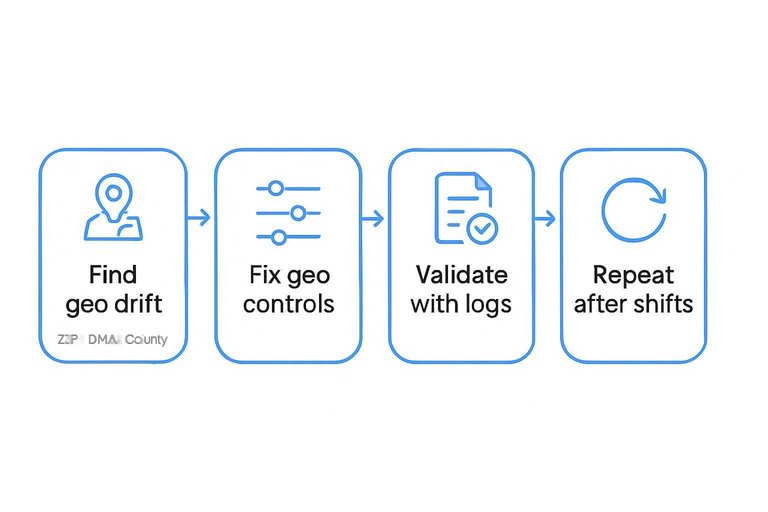
Fix geo controls
Most geo mistakes come from defaults. Fix them with explicit inclusions, hard exclusions, and documented settings.
- Build county inclusion lists for the whole flight.
- Add exclusions for out-of-state border zones.
- Use tight radii only when you can justify them.
- Set location to “presence,” not “interest.”
- Record each platform’s geo logic in your QA notes.
Treat geo like compliance: written, repeatable, and reviewed.
Validate with logs
Fixes aren’t real until delivery evidence matches your map. Validation protects you from quiet regressions and vendor hand-waving.
Use placement reports to confirm where impressions actually ran. Request publisher affidavits when inventory is syndicated. Spot-check delivery screenshots that show local context and timestamps.
If you can’t prove where it ran, you can’t defend what you bought.
Mistake 3: Audience Misfire
Primary voters aren’t the general electorate. If your targeting is built for November, you waste money in August.
Audience misfires usually come from sloppy definitions, stale models, and missing suppressions. Fix those first, then judge performance.
Audit audience sources
You can’t fix targeting until you know what’s driving it. Different sources behave differently, and recency quietly matters.
Check each audience input:
- Voter file match: match rate, district coverage, last refresh
- Modeled segments: training data, update cadence, confidence thresholds
- Interest proxies: exact interests used, how broad they are
- Lookalikes: seed quality, size, and similarity settings
- Contextual: placements, keywords, and topic exclusions
If you can’t explain your source, you can’t defend your spend.
Catch common errors
Most audience mistakes are boring and repeatable. They also get expensive fast.
- Mixing party universes across districts
- Missing absentee and early voters
- Skipping suppression of opponents’ universes
- Using overbroad “politics” interests
- Reusing a general-election persuasion pool
If the universe is wrong, the creative never gets a fair test.
Repair and retest
Don’t patch the old audience. Rebuild it, then prove it with clean comparisons.
- Recreate segments from the current voter file cut.
- Add suppressions for opponents, wrong districts, and known non-targets.
- Split test by audience type, not by tiny tweaks.
- Compare delivery, frequency, and cost by segment.
- Keep winners, then iterate one variable at a time.
Treat audiences like hypotheses, not possessions.
Ensure privacy compliance
Audience repairs can cross policy lines without you noticing. Primary data is political data, and platforms treat it that way.
Confirm your permitted data use, required disclaimers, and each platform’s political advertising rules before scaling. If compliance is fuzzy, stop and get it clean.
The fastest way to lose value is to “fix” targeting and trigger a denial or takedown.
Mistake 4: Inventory Mismatch
Choosing the wrong inventory breaks the chain between message and voter. You think you bought persuasion, but you often bought cheap impressions in the wrong rooms.
Classify inventory
Inventory labels hide real differences in attention, context, and targeting. In a Michigan Senate primary, each channel wins for a different reason.
CTV/OTT: big-screen attention, strong completion, weaker local news context.
Broadcast TV: mass reach fast, high trust environments, limited targeting.
Cable: zone and program control, solid frequency building, fragmented audiences.
Digital video: flexible targeting, variable quality, needs verification.
Display: efficient retargeting, low persuasion alone, heavy placement risk.
Audio/podcasts: high engagement, strong host adjacency, harder message recall.
Social: rapid testing, strong fundraising hooks, brand safety varies by placement.
Buy the format for the job, or your “reach” becomes expensive noise.
Identify wasteful placements
Bad inventory usually looks like “scale,” then performs like fog. Spot it before it eats your persuasion budget.
- Long-tail CTV apps with unclear content
- Made-for-ad sites posing as “news”
- Autoplay video with sound off
- Tiny units nobody can read
- No political adjacency or brand controls
If you can’t explain where it ran, you can’t defend why it worked.
Reallocate intelligently
You don’t need more spend to fix mismatch. You need tighter rules and cleaner supply.
- Pause placements failing viewability, completion, or fraud thresholds.
- Shift budget to verified sellers and authenticated inventory.
- Add channel-specific whitelists and block known junk domains and apps.
- Tune frequency caps by channel to prevent waste and burnout.
Clean supply turns the same message into a different outcome.
A good starting point is implementing ads.txt (Authorized Digital Sellers) checks across your programmatic buys.

Mistake 5: Frequency Waste
Too little frequency leaves voters unconvinced, even if your targeting is perfect. Too much frequency turns persuasion into irritation and drains budget fast.
You fix it by treating frequency like a system. Caps, sequencing, and flighting do the heavy lifting.
Diagnose frequency issues
Bad frequency rarely looks like “too high” or “too low” everywhere. It shows up as uneven pressure, hidden pockets, and performance that stops moving.
- Reach climbs, but frequency barely moves
- Frequency spikes by daypart or device
- Certain ZIPs get hammered repeatedly
- Outcomes plateau despite steady spend
- Retargeting outpaces prospecting impressions
If you see pockets of oversaturation, you’re not optimizing—you’re leaking.
Apply frequency controls
You need guardrails that match how each channel delivers impressions. Otherwise, the algorithm will happily spend into the easiest, not the best.
- Set frequency caps by channel and objective.
- Switch to reach-optimized buying when persuasion stalls.
- Separate prospecting and retargeting with different caps.
- Stagger flights to match the primary calendar moments.
- Review caps weekly and adjust for inventory shifts.
Control frequency, or frequency controls you.
Use message sequencing
Repetition works when each impression adds a new piece of meaning. Sequencing turns frequency from “same ad again” into a guided narrative.
Imagine a four-step order: introduce the candidate, contrast with the opponent, prove with credible specifics, then remind close to voting. Build rotations so the next impression unlocks the next message, not the same one on a loop.
If your frequency is rising, your information density must rise too.
Mistake 6: Measurement & Attribution Errors
Primary-market optimization now lives or dies on measurement. In a Michigan senate primary, you’re not just trying to “get impressions” — you’re trying to move persuasion and turnout signals in a short window, often with uneven media consumption across geographies and audiences. When measurement is built for a different era (or for a general-election scale), teams end up making confident decisions off incomplete data.
The core mistake: treating tracking like an afterthought, then expecting platform-reported conversions to explain voter behavior. Privacy changes, cookie limits, device-level restrictions, and walled-garden reporting all push you toward partial views of the funnel. If you don’t design for that reality from day one, you’ll misread what’s working, cut the wrong lines, and overspend on channels that simply report better.
In practice, measurement errors in a Michigan senate primary show up as:
- Over-crediting last-touch platforms that can claim view-through or click-through influence, even when persuasion is happening elsewhere.
- Under-counting cross-device and offline effects (a voter sees an ad on one device, later searches or votes without any “trackable” step).
- Optimizing to easy proxies (cheap clicks, video completion rates) that don’t map cleanly to persuasion or turnout.
- Ignoring lift and incrementality, assuming exposure equals impact.
The fix isn’t “perfect attribution” — that’s not available anymore. The fix is building a measurement plan that can survive partial signals and still tell you, directionally and repeatedly, whether you’re changing minds and motivating action.
Plan for signal loss, not ideal tracking
Assume you will not be able to follow a voter cleanly from impression to action. Build tracking around what you can reliably observe.
- Define a small set of primary KPIs tied to the objective (persuasion and turnout), and separate them from “comfort metrics.”
- Use multiple measurement layers: platform delivery + site analytics + CRM/list growth + controlled tests where possible.
- Treat reported conversions as partial and use them for trend direction, not final truth.
- Align creative and landing experiences to measurable actions (e.g., a clear volunteer/signup flow), while recognizing that voting itself won’t be a trackable conversion.
Separate persuasion measurement from turnout measurement
Persuasion and turnout behave differently and should not share the same success metric.
- Persuasion signals: message engagement quality (not just completion), repeat exposure patterns, shifts in issue-interest behaviors, and qualitative feedback loops.
- Turnout signals: deadline-driven behaviors (requests, reminders, location checks), reinforcement frequency near key dates, and audience “readiness” segments.
When you blend these, you’ll either over-serve persuasion audiences with GOTV creative or chase turnout metrics while the persuasion problem remains unsolved.
Use incrementality thinking, even if you can’t run perfect experiments
You don’t need lab-grade experiments to think incrementally.
- Holdouts where feasible: small geographic or audience holdouts can show directional lift without exposing the whole program.
- Time-based comparisons: look for performance changes around meaningful shifts (message change, budget move, format switch) while controlling for obvious external factors.
- Channel-role clarity: decide what each channel is supposed to do (introduce, reinforce, mobilize) and judge it against that role, not a generic CPA.
This avoids the classic primary mistake: reallocating budget toward the channels that measure best rather than the channels that persuade best.
Get your fundamentals right before launch
Measurement problems are hardest to fix mid-flight in a primary.
- Standardize naming and taxonomy across campaigns, geographies, audiences, and creative so you can read reports without guesswork.
- Audit pixels, tags, and event definitions (what counts as a signup, what counts as a completion) so different platforms aren’t optimizing to different “versions” of success.
- Decide attribution windows and reporting cadence up front, so you’re not changing rules midstream to justify a narrative.
- Build a simple “decision dashboard” that connects: spend → reach/frequency → key actions → inferred persuasion/turnout movement. If it can’t support a budget decision, it’s not a dashboard — it’s decoration.
Fix the Biggest Leak First—and Prove It
- Run triage first: define “lost value,” collect evidence, map the funnel, and set a baseline you’ll keep constant while testing.
- Start with the highest-leverage fixes in order: objective alignment → geo controls → audience sources/compliance → inventory reallocation → frequency caps and sequencing.
- Change one variable at a time, annotate the change, and validate with logs and funnel signals—not just top-line spend.
- Once the leak is plugged, document the corrected setup as your new default so the same mistake doesn’t creep back in during the next flight.
Frequently Asked Questions
- Does the Michigan Senate primary campaign strategy differ from the general election campaign?
- Yes—primary strategy usually prioritizes turnout and persuasion among likely primary voters, not broad reach. Your targeting, creative, and measurement should be built around primary electorate behavior and party rules, then rebuilt for the general.
- How do I measure whether my Michigan Senate primary ads are actually changing minds, not just generating impressions?
- Use controlled measurement where possible (A/B geo holdouts or matched-market tests) and track lift in high-intent actions like volunteer sign-ups, donations, and voter-file modeled support. Platform metrics alone (CTR, video views) often reflect delivery, not persuasion.
- What should I do if my Michigan Senate primary CPC/CPM looks efficient but my campaign isn’t gaining traction?
- Audit for signal quality by checking where ads served (placements), who saw them (voter-model overlap), and whether frequency reached persuasion levels in priority areas. Then validate with downstream indicators like precinct-level engagement, call time outcomes, and voter-contact conversion rates.
- Can I use voter file data for Michigan Senate primary targeting on Meta, Google, or programmatic platforms?
- Often yes via privacy-safe onboarding (hashed match lists) or modeled audiences, but availability and rules vary by platform and vendor. Use compliant uploads, exclude known supporters/opponents where allowed, and keep a clean refresh cadence to prevent stale targeting.
- How often should I refresh creative during a Michigan Senate primary to avoid ad fatigue?
- Refresh when frequency climbs and performance signals degrade (rising CPM, falling view-through rates, declining conversion quality), not on a fixed calendar. Rotate multiple message angles, update proofs and endorsements, and keep a clear sequencing plan so each exposure has a job.