
 Best Platforms
 Live Odds








9 Prediction Market Mistakes That Lead to Bad Fills
A practical prediction-market trade troubleshooter to diagnose and prevent bad fills—define what “bad” means for your trade, capture evidence, avoid spread traps and market-order sweeps, choose the right order type, translate prices into true probabilities, and size orders to real liquidity.
Ever placed a trade that “should” have filled near the displayed price—only to see it execute worse than expected? In prediction markets, small misunderstandings about spreads, order types, and depth can turn a clean idea into a frustrating entry.
This troubleshooter helps you triage what happened, collect the right evidence, and pinpoint the root cause. You’ll learn how to use limits instead of accidental market sweeps, read odds correctly, standardize safer defaults, and size orders to match liquidity.
Triage Your Fill
You can’t fix a “bad fill” until you know what kind of bad it was. Decide whether you’re facing pricing, order-entry, or market-structure friction before you touch your process.
Define “bad fill”
Bad fill can mean five different problems, and each points to a different fix. Pick one definition for this incident before you diagnose anything.
Slippage: you paid worse than the quote you expected.
Partial fills: you got less size than you wanted.
Queue position: you were “right” on price, but late in line.
Price improvement: you got filled better than your limit, but later than needed.
Opportunity cost: you didn’t fill, and the market moved away.
If you can’t name the failure mode, you’ll optimize the wrong knob.
Capture key evidence
You want enough detail to replay the moment without guessing. Write it down while it’s still fresh.
- Exact contract and outcome side
- Timestamp with time zone
- Order type and any flags
- Size and limit price
- Visible book state and spread
If you can’t reconstruct the scene, every conclusion will be vibes.
Reproduce the setup
Do a quick replay to separate a real market event from a stale display. You’re trying to confirm the market you thought you saw.
- Check recent trades around your timestamp.
- Reload the order book and watch it update.
- Compare the same market on web versus mobile.
- Verify your account has no mode or permission limits.
- Repeat with a tiny test order, if safe.
If the UI lied once, it will lie again until you catch the mismatch.
Classify root cause
Use a simple classification so you don’t mix execution errors with market realities. One label is enough to choose your next action.
| Symptom | Most likely cause | First check |
|---|---|---|
| Filled above limit | Wrong price | Order ticket values |
| Filled wrong amount | Wrong size | Size units, decimals |
| Bought instead of sold | Wrong side | Side toggle, defaults |
| No fill at fair price | Thin liquidity | Depth, spread |
| Quote moved instantly | Fast move | Recent trades cadence |
| Can’t place desired order | Platform constraints | Order types, limits |
Once you’ve tagged the cause, you can change one thing on purpose, not five things in panic.
Mistake 1: Ignoring Spread
Wide spreads are a fee you pay upfront. Thin top-of-book makes it worse, because your order eats the only real liquidity.
The “mid” can look fair while neither side will actually trade there. You learn that the hard way after an instant bad fill.
Spot a wide spread
Spreads widen when uncertainty spikes, and prediction markets do it fast. You need a quick read on spread, depth, and quote behavior.
- Check bid, ask, and compute the spread in ticks.
- Inspect size at best bid and best ask.
- Compare that size to your intended order size.
- Watch refresh speed during news bursts.
- Re-check after any headline or big print.
If the top-of-book looks like a puddle, the mid is basically fiction.
For more on how spread and depth are measured from limit order book data, see CME’s overview of spread, depth, and cost to trade.
Fix with limits
Market orders donate spread plus slippage. Limits let you decide what “bad” means.
- Start with a limit near your target, not at the ask.
- Use a small first clip to test real liquidity.
- Add a price ladder with a worst-case limit.
- Re-price only when the book actually moves.
- Scale in rather than clearing the level.
Your goal is to make sellers come to you, not chase them.
When crossing is fine
Crossing the spread can be rational when time matters more than price. It can also be fine when the spread is tight and steady.
Imagine you’re hedging a correlated position into a fast headline. Paying a tick or two may be cheaper than being unhedged.
Cross when urgency is real, size is small, or the spread stays stable under pressure.
Mistake 2: Market Orders
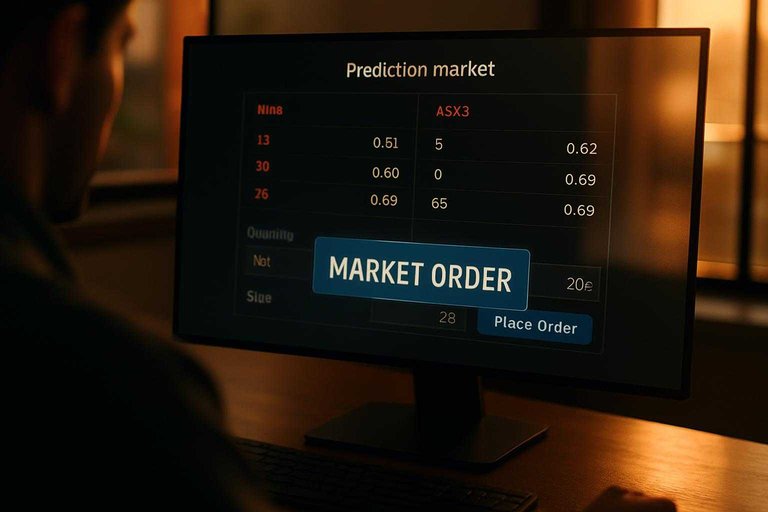
In prediction markets, the displayed price is often just the best available quote, not a promise for your full size. A market order accepts whatever liquidity exists, so it can fill across multiple levels and land far from what you first saw.
Sweep mechanics
A market order matches immediately against the order book, starting at the best price and walking outward. The bigger your order, the more levels it must consume, so your average fill drifts as soon as top-of-book liquidity runs out.
Imagine the screen shows 62¢, but only a small amount sits there. Your market order eats that, then hits 63¢, 65¢, and beyond until your size is done.
If you see a thin book, assume a market order will become a price-discovery tool.
Safer alternatives
Market orders trade certainty of execution for uncertainty of price. Use tools that cap the damage.
- Limit order to set a hard worst price
- Post-only to avoid crossing the spread
- IOC to grab some liquidity, then stop
- Reduce-only to avoid accidental position increases
- Max slippage controls if the venue supports them
Your edge rarely survives a bad fill, so make price control the default.
Emergency execution steps
You can still move fast without going blind. Treat it like controlled sprinting.
- Cap your order size to what top-of-book can plausibly handle.
- Place an aggressive limit that you can tolerate, not a market order.
- After any partial fill, re-check the book and your average price.
- Repeat in small clips until filled or conditions change.
Speed comes from iteration, not from surrendering the price.
Mistake 3: Wrong Order Type
Most “bad fills” aren’t bad markets. They’re bad order-entry.
On prediction venues, one toggle can flip you from maker to taker. Or silently change the order you thought you placed.
Type mismatch symptoms
You can usually spot an order-type mismatch before you blame liquidity. The pattern shows up in the tape and your activity log.
- Instant fill when you expected maker
- Repeated post-only cancellations
- “Price moved” or “invalid price” errors
- Partial fills that stop abruptly
- Orders that vanish after placement
Treat these as configuration bugs, not trading signals.
Verify platform rules
You’re checking definitions, not vibes. Different venues reuse the same words with different behavior.
- Confirm what IOC, FOK, and GTC mean on that venue.
- Check post-only behavior when your limit crosses the book.
- Verify min tick, rounding rules, and valid price increments.
- Review how edits affect queue priority and maker status.
- Read how hidden conversions work, like marketable limits becoming takers.
Once you know the rules, you can predict the fill before you click.
Standardize your defaults
Reduce choices at entry, and you reduce mistakes. Your default template should optimize for “no surprises,” not speed.
Use a limit order with GTC as your baseline. Make time-in-force explicit every time, even if the UI shows a default. Keep a few size presets so you don’t fat-finger notional versus contracts.
When the unusual trade comes up, you’ll change one setting on purpose, not three by accident.
Mistake 4: Misreading Odds
Misreading odds usually isn’t about math. It’s about mixing up probability, payout conventions, and settlement rules. You end up paying a “fair” price for the wrong thing.
Price-to-probability
A contract’s price is a probability shorthand, but only inside that platform’s payout convention. If “YES” settles to 1 and “NO” to 0, a price near 0.62 reads like ~62% implied probability.
Fees, spreads, and how you exit shift the breakeven. Imagine you buy YES at 0.62, pay fees to enter, then pay fees again to sell early. Your true break-even probability is higher than 62%, even if the chart makes it look clean.
Treat the displayed price as a starting estimate, not your final effective price.
Settlement gotchas
Settlement rules decide what “wins,” even when the real-world outcome feels obvious.
- Ambiguous resolution sources and conflicting official statements
- Deadline cutoffs that ignore late-arriving results
- Rule changes or clarifications after trading begins
- Multi-outcome mechanics that dilute “YES vs NO” intuition
- Void conditions that refund or force a specific settlement
If you can’t state the exact settlement trigger, you’re not trading probability. You’re trading interpretation risk.
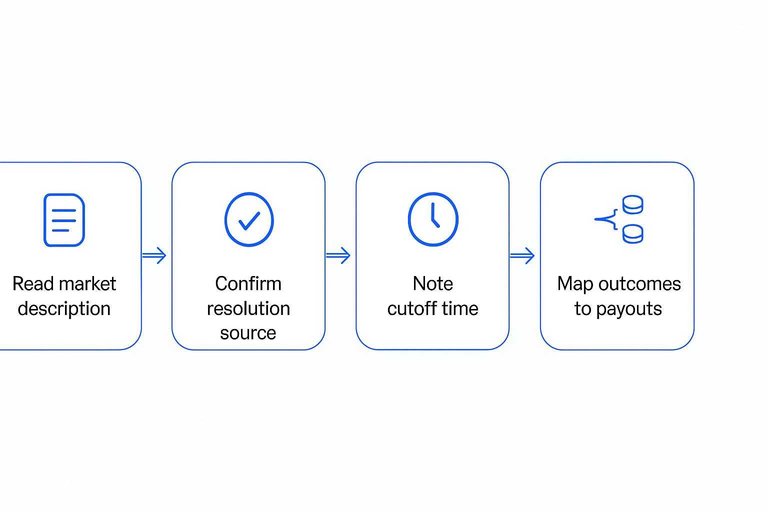
Pre-trade checklist
Do this every time, especially on markets that look “obvious.”
- Read the full market description, not the title or banner.
- Identify the resolution source and confirm it’s unambiguous.
- Note the cutoff time, timezone, and what counts as “final.”
- Scan for void, cancellation, or exceptional-conditions clauses.
- Map outcomes to payouts, including multi-outcome settlement details.
You’re not hunting certainty. You’re hunting a contract you can’t misunderstand.
If you want a platform-specific example of how these mechanics can matter, Polymarket notes cases where outstanding limit orders cancel at game start.
Mistake 5: Over-Sizing
Oversizing is when your order is bigger than the available depth near the current price. Your average fill drifts fast because you chew through levels.
It also broadcasts urgency. Other traders see you sweeping the book and adjust against you.
Measure depth fast
You need a quick read on depth before you click size. It keeps your estimate grounded in what the book can actually absorb.
- Check top-of-book depth on both sides, not just the best price.
- Scan two to four levels deep and total the shares you would consume.
- Look at the last few prints and note typical trade size.
- Compare your intended size to recent volume and visible depth.
- Re-price your expected average fill after each level you’d hit.
If your order consumes multiple levels, you’re not “trading,” you’re moving the market.
Use slicing tactics
Big intent doesn’t require big tickets. You can express the same view with less footprint.
- Split one order into many smaller clips
- Time entries around natural flow, not boredom
- Randomize clip sizes to avoid a pattern
- Use passive quotes and let fills come
The goal is to look like background noise, not a siren.
Know when to stop
Oversizing often turns into chasing. You keep “just needing a bit more,” and the price keeps moving away.
Set stop conditions before you start: an adverse move beyond your limit, a widening spread, a sudden news spike, or repeated partial fills that get worse each time. When one hits, pause and re-price the whole plan.
Good traders stop on signals. Not feelings.
Venue Mechanics That Quietly Worsen Fills
Many “bad fills” in prediction markets aren’t caused by your thesis or timing—they’re caused by the plumbing of the venue you’re trading on. Two trades that look identical on the screen can have meaningfully different outcomes once you factor in fees, rebates, queue priority, partial-fill behavior, and the practical friction of settling and getting funds out.
Before blaming spread, slippage, or your order type, take a minute to model what the venue actually does to your execution. Small mechanical differences compound quickly, especially when you scale size or trade frequently.
Fees, rebates, and the true break-even price
Fees don’t just reduce profit; they change what counts as a “good” fill. A price that looks favorable can become mediocre once you include:
- Per-trade fees that apply to each fill (and can stack if you get split across many partial fills).
- Settlement or redemption fees that show up later, after you’ve already committed to the position.
- Rebates or maker incentives that effectively improve your net execution—but only if you actually qualify as maker under the venue’s rules.
Practical check: calculate your “all-in” entry price (including expected fees) and compare that to your target edge. If you can’t write down a net break-even, you’re guessing.
Maker–taker rules and queue priority surprises
Some venues reward liquidity providers (maker) and charge liquidity takers (taker). Others have more nuanced rules about what counts as maker, including:
- Post-only orders that still become taker if the venue re-prices or matches in unexpected ways.
- Time/price priority that makes your limit order sit behind older orders at the same price.
- Self-trade prevention, minimum size, or “hidden” priority rules that can cause your order to behave differently than you expect.
If you’re consistently getting worse-than-expected fills at the same quoted price, you may not actually be earning maker treatment—or you may be losing queue priority and getting filled only when the market moves against you.
Partial fills and average-price traps
In prediction markets, it’s common to get filled in pieces—especially around popular strike levels (e.g., near 50%) or when liquidity is thin. Partial fills can create a misleading sense of control:
- You place a limit expecting a single fill, but instead receive multiple small fills at different moments.
- Your average entry ends up worse than the first print you noticed.
- You accumulate exposure gradually and accidentally “chase” the market as you keep re-posting to complete the size.
Practical check: decide in advance whether you prefer (a) accepting partials up to a maximum size, or (b) canceling if you don’t get a meaningful fill quickly. Also review how the venue reports average fill price—some interfaces emphasize the best fill rather than the average.
Settlement and withdrawal frictions that change your execution choices
Execution isn’t only about the moment you enter; it’s also about how easily you can exit, settle, and redeploy capital. Venue-specific frictions can turn an “acceptable” fill into a bad one because they force you into suboptimal behavior:
- Long or uncertain settlement timelines may lock up capital and pressure you to use marketable orders to exit earlier.
- Withdrawal holds, conversion steps, or limited payout rails can create urgency at the worst time.
- Position transfer restrictions can prevent you from moving exposure to a better venue, trapping you in poor liquidity.
If you know settlement/withdrawal is slow or operationally annoying, you’re more likely to overpay for immediacy—so bake those constraints into your plan instead of discovering them mid-trade.
A quick venue-mechanics checklist before you place size
Use this checklist when you’re about to scale up or trade a new market:
- What are the taker fees and do they apply per fill?
- Do you get a maker rebate, and what disqualifies you from it?
- How does the venue define maker vs taker for “post-only” or price-improving orders?
- What’s the minimum order size and does it increase partial-fill frequency?
- How does the venue display average fill price and fees in the trade history?
- What are the settlement steps and any practical withdrawal constraints?
If you can’t answer these quickly, treat your next trade as a test size—not a full-size position.
Run This Bad-Fill Checklist Before Your Next Click
- Define “bad fill” for this trade: compare your fill to the mid, best bid/ask at the moment, and your intended max slippage.
- Capture evidence: screenshot/order ID, timestamp, visible book/spread, your order type, and any partial fills.
- Reproduce the setup: check whether the spread widened, the top of book moved, or depth thinned right as you submitted.
- Default to limit orders: set a price you’re willing to pay/accept and a size you can reasonably get without moving the book.
- Verify order type rules: confirm how your platform treats market orders, “post-only,” reduce-only, and partial-fill behavior.
- Translate price ↔ probability: sanity-check implied odds, contract terms, and settlement edge cases before entering.
- Size to liquidity: scan depth, slice into smaller orders, and stop when you’re chasing the book instead of taking it.
Frequently Asked Questions
- Do limit orders always protect me from bad fills in prediction markets?
- No. A limit order caps your worst price, but you can still get partial fills, queue behind other orders, or miss trades entirely if the market moves away before you’re filled.
- How can I tell if a prediction market is too illiquid to trade?
- Check the bid-ask spread, the size available at the best bid/ask, and how quickly quotes update after small trades. If the spread stays wide and depth is thin across multiple price levels, fills will usually be worse and harder to control.
- What’s the safest way to place larger trades in prediction markets without moving the price?
- Split your order into smaller limit orders and work them over time near the top of book rather than crossing the spread all at once. If the platform supports it, use iceberg/hidden-size features carefully and monitor the fill quality as you go.
- How do I measure fill quality in prediction markets if the “mid price” isn’t reliable?
- Compare your execution to the best bid/ask at the moment you placed the order and to the volume-weighted average price (VWAP) over your execution window. Track slippage in probability terms (e.g., paid 0.62 vs best ask 0.60) so you can compare across markets consistently.
- Can fees and platform rules cause unexpected effective prices in prediction markets?
- Yes. Trading fees, maker/taker schedules, and settlement or redemption mechanics can change your net outcome even if the fill price looks fine, so always review the fee schedule and contract specs before sizing up.