
 Best Platforms
 Live Odds








CoinRithm Prediction Markets Review: Features, Integrations, Limitations
Review of CoinRithm for cross-venue market discovery: Reference Probability, quality/spread signals, APIs (keyless/agent/MCP), paper agents, and limits.
You’re trying to scan a fast-moving question across multiple venues without flipping through tabs and second-guessing which price is real, comparable, or just thin and misleading.
If you get it wrong, you waste time, anchor on bad odds, or build a workflow that breaks the moment you automate it or try to paper-test a strategy. This review walks you through what CoinRithm actually aggregates, what its core trader surfaces are meant to prevent, how its APIs and agent stack fit into a developer workflow, and the specific limitations that decide a clean go/no-go.
CoinRithm, Defined
CoinRithm is a two-part product: a prediction-markets aggregator (it pulls the same question from multiple venues into one view) plus a sandbox (it lets you test ideas with paper trading and agent workflows using virtual funds).
On the aggregation side, CoinRithm collects questions, probabilities, liquidity, volume, status, and other metadata from a mixed set of venues and forecast platforms—then normalizes fields where it can, while leaving settlement rules and access limits source-specific.
What CoinRithm is not: it’s not an execution venue or a broker. You don’t use it to route and settle real-money orders across exchanges. Even its simulator draws a bright line: event pages label venue terms as informational and state CoinRithm paper trading uses its own rules.
The “research tool, not a pipe” distinction shows up in the Terms: CoinRithm restricts “Market Data” to reading live context for paper-trading decisions/analysis and to scoring against settled outcomes, and it prohibits redistribution/resale/republishing and using Market Data to facilitate real-money trading. Treat CoinRithm as discovery + testing—then decide separately where you’ll actually execute.
Scope snapshot
- Tracked sources: Polymarket, Kalshi, Metaculus, PredictIt, Limitless, Manifold Markets, Smarkets, Robinhood (Rothera), Futuur, Myriad, ForecastEx, Gemini.
- Tracked markets: 52,593 open; 1,623,386 total since launch.
- Activity: $82.6M traded across prediction markets in the last 24 hours (real-money venues only).
- Access: Free tier available; pricing is not publicly listed.
- Entry point: CoinRithm prediction markets stats (external link, rel=“nofollow”).
Trader Core Surfaces
CoinRithm is easiest to use when you treat it like three trader “surfaces,” each designed to stop a different kind of mistake: (1) anchoring on one venue’s price, (2) getting baited into a thin market that can’t actually absorb size, and (3) assuming “resolved” means the same thing everywhere. (A quick way to decide which events are even worth drilling into before you do this deeper work is to start from a cross-platform scanner like MarketsPrediction, then switch into CoinRithm when comparability and auditability matter.)
Reference Probability logic
The Compare/Sources view matters because it forces you to look at matched questions—CoinRithm’s grouping of “the same bet” across venues—before you start believing any single number. That’s where you’ll see CoinRithm’s Reference Probability (its single consensus probability for a matched question, computed across real-money venues and shown with venue count and a disagreement spread) instead of a simple average across every platform that publishes a percent.
Under the hood, CoinRithm uses a liquidity-capped weighted median (an aggregate that weights venues by liquidity but limits how much any one venue can dominate, then takes the median—not the average—to reduce outlier/manipulation impact) across real-money venues, explicitly excluding play-money and forecast platforms from that reference number. It also clamps the liquidity weights with a floor of about $1,000 and a cap of about $50,000, which is a quiet but meaningful defense against “one tiny venue prints a weird price” and “one huge venue steamrolls the whole consensus.”
The differentiator here isn’t “it shows you prices” (that’s table stakes). It’s that the consensus number is intentionally built to be hard to bully.
Disagreement and quality
CoinRithm doesn’t let the reference number appear as a lone oracle: it’s always displayed with a venue count and a spread (for example, “62% · 3 venues · ±4 pts”). That venue spread (± pts) (a points-based measure of how far apart the matched venues’ probabilities are; it’s the “they disagree” signal shown alongside the reference number) is your first alert for single-venue bias: if the spread is wide, you’re not looking at “the market,” you’re looking at an argument between markets.
When you’re trying to avoid thin-market traps, the other core signal is the 0–100 Quality score. CoinRithm defines it from five components—liquidity, bid-ask spread, 24h volume, data freshness, and probability-book structure—and it applies “honesty caps” so certain thin/inactive/incomplete/stale markets cannot score above a stated ceiling. That’s not about being fancy; it’s about refusing to give a fragile market a confidence-looking badge.
Comparability warnings
Even when two venues look “matched,” they can still be non-comparable in the way that hurts traders most: settlement. That’s why you should actively look for venue-by-venue notes and the event’s settlement provenance (a record on an event page describing what outcome was recorded and when—and whether it was revised—intended to make resolution evidence inspectable) before you treat a backtest or paper result as transferable.
Two practical comparability tripwires show up a lot:
First, vig adjustment (CoinRithm’s normalization step that removes overround/margin from a complete outcome book; when the book is incomplete, raw quotes are shown instead of estimated). If you miss whether you’re looking at adjusted or raw quotes, you can think you’ve found an edge that’s really just a pricing convention.
Second, CoinRithm is explicit that third‑party market data can be incomplete or wrong, and it doesn’t guarantee uninterrupted availability or error-free upstream feeds. So the “resolution evidence” surface isn’t decoration; it’s how you audit what CoinRithm thinks happened when a market flips to resolved.
If you want a faster “what’s moving right now” scan—especially when you care about quickly comparing live odds and activity across platforms—MarketsPrediction is built for that kind of browsing; CoinRithm’s edge is making cross-venue comparability (and its failure modes) impossible to ignore.
APIs and Agent Stack
CoinRithm gives you three integration paths with different guarantees: a keyless GET-only surface, a keyed agent API for continuous polling + paper-trade writes, and an MCP server endpoint for tool-calling agents.
A Keyless API (public HTTPS GET endpoints with no API key) is for lightweight reads: quick market lookups, occasional dashboards, and manual analysis. Responses are cached (~15 seconds), sustained polling is rate-limited, and there’s no uptime SLA.
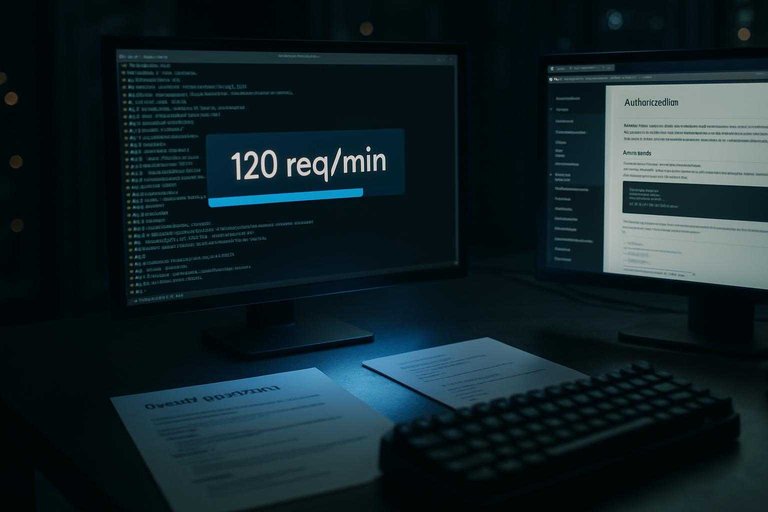
A keyed agent API (authenticated endpoints using keys that look like crk_live_…) is for continuous polling and paper-trade writes. It’s the “build something that runs every minute” surface, with defined rate budgets (120 req/min reads; 20/min writes) and a versioned OpenAPI 3.1 contract.
MCP (Model Context Protocol) is a standard that lets LLM clients discover and call tools. CoinRithm exposes its agent trading/data tools through an MCP server endpoint, so your assistant can tool-call instead of screen-scraping or guessing URLs.
Integration options table
| Integration path | Best for | Cache window | Uptime SLA | Rate budgets (reads/writes) | Contract |
|---|---|---|---|---|---|
| Keyless JSON (public GET) | Light reads | ~15 seconds | None | Sustained polling rate-limited | Not promised |
Keyed agent API (crk_live_…) |
Continuous polling + paper writes | Not published | Not published | 120 req/min reads; 20/min writes | Versioned OpenAPI 3.1 |
| MCP server endpoint | Tool-calling agents | N/A | Not published | Not published | MCP tool schema |
Paper agents workflow
If you’re building a “paper agent,” the clean path is: start a Mock Trade paper account, then let an agent run on CoinRithm’s 1‑minute cadence while it reads markets and submits paper orders.
The keyed agent API is the connective tissue here: you import the published OpenAPI schema (a machine-readable API description) into your client, generate or validate requests against it, and then run a tight loop—fetch state, decide, place paper trades—without abusing the keyless endpoints.
If you want the agent to live inside an LLM toolchain, MCP is the more natural fit. CoinRithm runs a hosted MCP trading server and lists Claude and ChatGPT (via a Custom GPT Action) as supported clients, which turns “call the trading tool” into a first-class capability instead of a bespoke integration.
Finally, if you care about benchmarking, Agent Arena makes performance visible via a public leaderboard of realized paper PnL—which is useful precisely because it forces your integration to be repeatable, not a one-off notebook script.
The “Free API” Dispute
The dispute isn’t whether CoinRithm has a keyless, production-reachable endpoint. It’s whether “free/production” means “OK to build a downstream data product on top of this.”
CoinRithm’s Terms of Use draw a hard line on automation: they prohibit using “data mining, crawling, ‘scraping’, robot or similar automated” methods to access, acquire, monitor, or copy parts of the service unless you’re expressly authorized. That matters to builders because the thing you call “an API integration” (continuous polling, bulk collection, scheduled backfills) is exactly what those Terms treat as automated acquisition.
The same mismatch shows up in how developers typically use market data. A production app usually ingests, stores, and then republishes odds/metadata to users or customers. CoinRithm’s “Market Data” framing is narrower: the Terms are written to allow reading live context for paper-trading decisions/analysis and scoring against settled outcomes, while prohibiting redistribution/resale/republishing and use in competing products.
Finally, don’t confuse “data coverage” with “execution scope.” CoinRithm aggregates many sources, but its own agent trading repo explicitly describes prediction-market paper trading on Kalshi and Polymarket under one balance—so you can often observe more venues than you can paper-execute against inside CoinRithm.
If you need republishable, builder-friendly odds for a public-facing product, plan on sourcing data where redistribution is actually permitted (including alternatives like MarketsPrediction) rather than discovering that constraint after you’ve shipped.
Where It Breaks Down
CoinRithm is strongest as cross-venue context plus a sandbox. It breaks down when you treat it like a republishable data feed, a real-time trading signal, or a venue-faithful simulator.
-
Legal/data-use boundaries become product constraints. “Market Data” is framed for on-site reading (analysis and paper decisions) and for scoring against outcomes—not for redistribution or building a downstream odds product. That turns “store it and serve it to users” into a non-starter.
-
Freshness isn’t guaranteed end-to-end. The keyless surface is cached, and upstream feeds can be incomplete or temporarily unavailable.
-
Coverage gaps can be structural, not bugs. Source coverage varies by venue and data availability, and some histories start only from a venue’s API era (for example, from a CLOB—central limit order book—cutover), which can quietly break backtests.
-
Simulator realism has explicit limits. Event pages state venue terms are informational and that CoinRithm paper trading uses its own rules. If your edge depends on venue mechanics (minimum size, early close, settlement timing), paper results won’t be venue-transferable.
-
Cross-venue “activity” comparisons can mislead. Venues don’t share one definition of “24h volume,” and CoinRithm’s own quality scoring saturates: its liquidity component reaches full credit near $2.5M, so deeper markets can look similar on that axis.
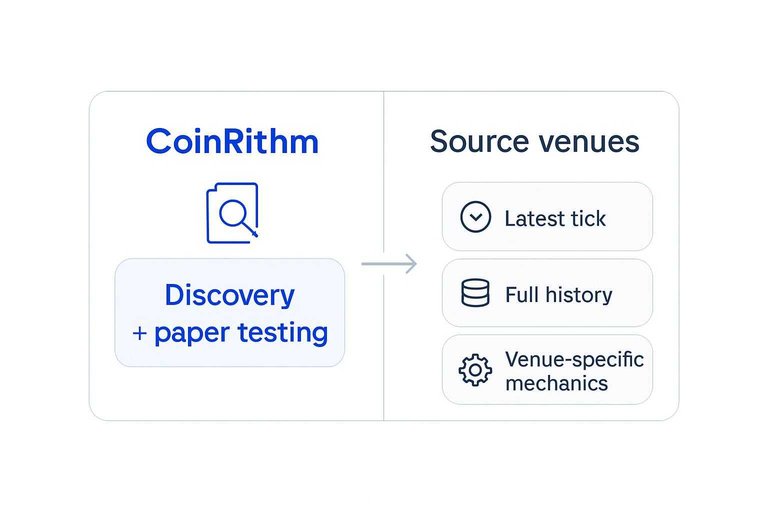
If any of those are dealbreakers, the practical adjustment is to keep CoinRithm for discovery + paper testing, and rely on the source venues for the “latest tick,” full history, and venue-specific mechanics.
Go/No-Go Decision
Use CoinRithm when your job is “cross-venue context + testing,” and pass when your job is “republishable data feed” or “venue-faithful execution.” Here’s a workflow-first way to decide.
Scan (trader / discretionary): Start from the ranked-by-live-volume discovery view, then open the event and immediately sanity-check the cross-venue match. If the venues disagree widely, treat it as “markets arguing,” not “the market.” Before you act on any apparent edge, click through to the underlying venue pages and verify two things CoinRithm can’t make true for you: (1) you’re eligible to trade there (jurisdiction, account/KYC rules), and (2) the resolution criteria (what source resolves it, when it can resolve, and what counts as a valid outcome).
Cite (research / analysis): If you need to reference a price or probability in writing, don’t stop at the aggregate view. Capture the specific venue context (market rules + resolution wording) and the event’s resolution evidence trail so your citation survives a later dispute or revision. Also assume upstream data can be incomplete or wrong; when the claim matters, confirm it at the source.
Prototype (bot / agent paper testing): Green-light CoinRithm if your goal is a paper agent loop (read → decide → submit paper trades) on its provided cadence and tooling. Red-flag it if your prototype requires “always-fresh” ticks, uninterrupted upstream feeds, or a simulator that mirrors venue mechanics exactly.
No-go (builder / competitor-aggregator): If your product roadmap includes storing, redistributing, or republishing odds/metadata—or using the data to facilitate real-money trading—stop and source data where that downstream use is explicitly permitted.
MarketsPrediction alternative
When CoinRithm’s limits bite—especially if you mainly want cross-platform browsing—MarketsPrediction is the cleaner fit for “what’s moving right now” scanning: cross-platform live odds, trending feeds, category/platform filters, top-by-volume lists, and platform comparison tables. Its pages show a visible “Last updated” timestamp for live data, and its promo/offer tiles include eligibility limits (18+ and a legal U.S. residential address) that you still need to validate against the destination platform before acting.
MarketsPrediction alternative
When CoinRithm’s limits bite—especially if you mainly want cross-platform browsing—MarketsPrediction is the cleaner fit for “what’s moving right now” scanning: cross-platform live odds, trending feeds, category/platform filters, top-by-volume lists, and platform comparison tables. Its pages show a visible “Last updated” timestamp for live data, and its promo/offer tiles include eligibility limits (18+ and a legal U.S. residential address) that you still need to validate against the destination platform before acting.
Pick one role for CoinRithm
If your goal is to stop anchoring on a single venue, avoid thin-market traps, and keep settlement differences visible, CoinRithm earns a “yes” as a cross-venue research surface—especially when you lean on Reference Probability plus the venue spread and then paper-test with its agent loop. But treat it as discovery and simulation, not a pipe: its Terms and data-use boundaries block “store and republish,” its keyless data can be cached, upstream feeds can be incomplete, and its paper rules don’t mirror venue mechanics. When what you need first is a fast “what’s moving right now” browse across platforms—trending lists, filters, top-by-volume views, and platform comparison tables—MarketsPrediction is the cleaner front door, with the explicit trade-off that its live data is presented with a visible “Last updated” timestamp rather than pretending to be a continuous tick feed. Decide which job you’re doing, then build the workflow around that choice instead of forcing one tool to be an exchange, a data vendor, and a simulator all at once.
Frequently Asked Questions
- Can I use CoinRithm as a real-money trading terminal to place orders across prediction markets?
- No—CoinRithm is an aggregator and paper-trading sandbox, not an execution venue or broker. Use it for discovery and testing, then place real-money trades directly on the underlying venue you’re eligible to use.
- Is CoinRithm’s Keyless API actually “free to use” for building a public odds site or redistributing market data?
- No—having keyless GET endpoints isn’t the same as permission to store and republish the data in a downstream product. If your roadmap includes redistribution, use a data source that explicitly allows republishing instead of treating CoinRithm as a feed.
- What’s the difference between CoinRithm’s paper trading and venue-faithful simulation on Kalshi or Polymarket?
- CoinRithm paper trading runs on CoinRithm’s own simulator rules, so results aren’t mechanically identical to trading on any specific venue. If your strategy depends on venue mechanics (like minimum size or settlement timing), validate it on the source venue before trusting the backtest.
- How should I sanity-check a “matched question” in CoinRithm before I trust the cross-venue probability?
- Open the underlying venue pages and compare the exact resolution criteria and settlement wording, then confirm you can actually trade the market (jurisdiction/KYC/account rules). Treat large cross-venue disagreement as “markets arguing,” not a single tradable consensus.
- If I mainly want to see what’s moving right now across platforms, should I start with CoinRithm or MarketsPrediction?
- Start with MarketsPrediction for fast cross-platform browsing (trending markets, filters, and top-by-volume lists), then switch to CoinRithm when you need deeper comparability checks and paper-testing workflows. This keeps scanning and auditing as two separate steps instead of forcing one tool to do both.