
 Best Platforms
 Live Odds








FIFA World Cup who will win: 11 market metrics for 2026
This case study puts World Cup winner markets on equal footing in 2026 — contract normalization (same question/window/settlement), bid/ask-to-cost translation with fee-adjusted spreads, depth/open interest and 24h-vs-lifetime activity checks, rules/access/resolution risk flags, and a pre- vs post-final walkthrough using MarketsPrediction.
You’re trying to figure out where the “World Cup winner” price is actually tradable, not just clickable. But when different venues label similar-looking markets, show different odds formats, and highlight different activity stats, it’s easy to compare the wrong thing and think you’ve found value.
Get it wrong and you can pay an extra spread, fail to get filled in size, or discover too late that the contract settles on a different definition—or that you can’t even open the position from your location. This case study gives you an 11-metric rubric that normalizes the contract, turns quotes into real cost, and separates headline volume from execution quality and rule risk.
Normalize the contract
Before you rank any “World Cup winner” markets for fifa world cup who will win, normalize the contract—the exact question a market settles on. If two venues aren’t asking the same thing, over the same time window, with the same settlement rule, any “best price” comparison is junk math.
Same question
- Confirm it’s the tournament winner. You want “wins FIFA World Cup 2026™,” not “wins the final,” “wins Group X,” or “lifts the trophy (incl. DQ)” unless every venue uses that same phrasing.
- Match the outcome set. Every venue should list the same teams for the same tournament. If one market is missing teams or uses a different mapping (e.g., a combined label), you’re not comparing like-for-like.
- Check whether it’s one multi-outcome market or many YES/NO markets. Both formats can represent “winner,” but they behave differently (especially when you try to compare implied probabilities across venues).
- Scan for conditional wording. Anything that depends on another event (“if they qualify,” “if X happens”) is a different question.
Same window
Anchor the market to FIFA’s published tournament window: the first match on June 11 through the final on July 19, 2026. That’s the event you’re trying to trade, so your “winner” contract should live and die inside those dates.
Watch for in‑play behavior: some venues keep winner markets open deep into the tournament, while others close at a specific cutoff (sometimes earlier than you expect). If you’re comparing prices mid‑tournament, only compare markets that are still accepting new orders at that moment—otherwise you’re ranking a live quote against a frozen one.
Same settlement
Settlement is simply how the venue decides the outcome and pays out. Read the market’s rules text, not just the headline. For example, some platforms expose explicit rule fields (like primary/secondary rules) right on the market object, which makes it easier to verify you’re trading the same settlement definition across listings.
Also normalize the payout model. On Kalshi-style event contracts, a correct contract settles to $1 and an incorrect one to $0 (with prices quoted between $0.01 and $0.99). On Polymarket, winning shares pay $1 and resolution runs through the UMA Optimistic Oracle, with a defined dispute window (a 2‑hour challenge period after a resolution is proposed).
When you want an unambiguous settlement input, use an official match report. FIFA’s final report for July 19, 2026 states Spain became world champions by beating Argentina 1–0 in New York New Jersey—clean evidence a correctly-written “tournament winner” market can resolve against.
Once these three checks line up, differences you see in price and activity are about the market—not about mismatched fine print.
Same question
- Confirm it’s the tournament winner. You want “wins FIFA World Cup 2026™,” not “wins the final,” “wins Group X,” or “lifts the trophy (incl. DQ)” unless every venue uses that same phrasing.
- Match the outcome set. Every venue should list the same teams for the same tournament. If one market is missing teams or uses a different mapping (e.g., a combined label), you’re not comparing like-for-like.
- Check whether it’s one multi-outcome market or many YES/NO markets. Both formats can represent “winner,” but they behave differently (especially when you try to compare implied probabilities across venues).
- Scan for conditional wording. Anything that depends on another event (“if they qualify,” “if X happens”) is a different question.
Same window
Anchor the market to FIFA’s published tournament window: the first match on June 11 through the final on July 19, 2026. That’s the event you’re trying to trade, so your “winner” contract should live and die inside those dates.
Watch for in‑play behavior: some venues keep winner markets open deep into the tournament, while others close at a specific cutoff (sometimes earlier than you expect). If you’re comparing prices mid‑tournament, only compare markets that are still accepting new orders at that moment—otherwise you’re ranking a live quote against a frozen one.
Same settlement
Settlement is simply how the venue decides the outcome and pays out. Read the market’s rules text, not just the headline. For example, some platforms expose explicit rule fields (like primary/secondary rules) right on the market object, which makes it easier to verify you’re trading the same settlement definition across listings.
Also normalize the payout model. On Kalshi-style event contracts, a correct contract settles to $1 and an incorrect one to $0 (with prices quoted between $0.01 and $0.99). On Polymarket, winning shares pay $1 and resolution runs through the UMA Optimistic Oracle, with a defined dispute window (a 2‑hour challenge period after a resolution is proposed).
When you want an unambiguous settlement input, use an official match report. FIFA’s final report for July 19, 2026 states Spain became world champions by beating Argentina 1–0 in New York New Jersey—clean evidence a correctly-written “tournament winner” market can resolve against.
Turn quotes into cost
Steps
-
Pull the executable quote (best bid / best ask).
Best bid / best ask means the highest price someone is willing to pay (bid) and the lowest price someone will sell for (ask); together they define the executable price range right now. On venues that expose it directly, you can read fields like yes_bid_dollars and yes_ask_dollars from the market object. On Polymarket, pin the exact market you’re quoting by its conditionId (and the Gamma ID/slug used in links) so you don’t compare two similarly named “World Cup winner” listings. On Kalshi’s public order book feed, you’ll see bids on each side, and the ask is implied as $1.00 − (opposite-side bid). -
Convert the quote into an implied probability range.
On $0–$1 winner-style contracts, the displayed price is already a probability in dollars. So the market is saying “right now, executable probability is between bid and ask.” -
Compute the raw spread.
Bid-ask spread (raw vs fee-adjusted) means the gap between best bid and best ask; fee-adjusted spread includes the venue’s trading fees for entering/exiting. Raw spread is just:
- Raw spread = ask − bid
(Example: if bid is $0.41 and ask is $0.43, raw spread is $0.02.)
- Decide whether you’re a maker or a taker, then price fees accordingly.
Maker vs taker means a maker posts resting limit orders (providing liquidity); a taker executes immediately against resting liquidity. On Polymarket, makers are never charged; taker fees (when enabled) are:
- fee = C × feeRate × p × (1 − p)
For Sports, Polymarket lists feeRate = 0.05, plus a 15% maker rebate (a payment that rewards liquidity providers whose limit orders get filled).
- Turn raw spread into “true” (fee-adjusted) spread.
Treat entry and exit separately:
- Taker buy cost ≈ ask + buyFee/share
- Taker sell proceeds ≈ bid − sellFee/share
- Fee-adjusted spread ≈ (ask + buyFee) − (bid − sellFee)
On Kalshi, the published fee schedule makes the punchline obvious: 100 contracts at $0.50 costs $1.75 in trading fees, i.e., $0.0175 per contract per side. A “tight” $0.02 raw spread can stop being tight the moment you pay taker-like round trips.
The 11-metric rubric
Order-book depth (how many shares/contracts are available at and near the current price) is the first “liquidity” filter, because depth determines whether you can trade size without moving the market. Open interest (the amount of outstanding positions/contracts still open) tells you how much risk capital is actually committed, not just churned. And 24-hour volume vs lifetime volume (recent trading activity versus total traded historically) keeps you focused on what’s tradable today.
| Metric | Pull it from (UI/API) | “Good” signal | What it implies (execution/risk) |
|---|---|---|---|
| Fee-adjusted spread | Best bid/ask in market object | Tight after fees | Lower round-trip drag |
| Near-touch depth | Order book top levels | Size at best prices | Less slippage on entry |
| Depth within X cents | Order book price ladder | Depth 1–5¢ out | You can scale in/out |
| 24h volume vs lifetime | Market fields: 24h + total volume | 24h not tiny | Activity is current, not stale |
| Open interest | Market field: open interest | OI holds up | Capital committed, not churn |
| Recent trade recency | UI trade tape / trades feed | Trade just happened | Book isn’t “painted” |
| Quote source fidelity | Order book math vs displayed ask | Ask is consistent | Avoids phantom tightness |
| Rules text quality | Rules fields on market | Specific settlement rules | Fewer nasty surprises |
| Market state / access | API state flags | acceptingOrders=true | Not view-only / close-only |
| Clarification behavior | Venue policy docs | No surprise resets | Clarifications can nuke rests |
| Resolution / disputes | Oracle + dispute window | Clear, monitorable | Missed windows = real risk |
Where to actually pull these without guessing: Kalshi’s Get Market endpoint exposes best prices plus volume (24h and total) and open interest alongside rules fields, and its public order book endpoint is unauthenticated and returns bids (with asks implied as $1.00 minus the opposite-side bid). Kalshi also states members can view depth up to the fifth price level. On Polymarket, the market data model includes state flags like acceptingOrders and a restricted flag, clarifications explicitly clear the book and cancel resting orders, and resolution runs through UMA’s Optimistic Oracle with a 2-hour challenge period; Polymarket also blocks U.S. users and prohibits VPN bypass.
If your “best” World Cup winner market can’t score well on the first six rows, it’s popular—not tradable.

When volume misleads
Big volume is a popularity signal, not an execution guarantee. A contract can print enormous lifetime turnover—Kalshi’s World Cup winner market was reported at $1.2 billion—and still be hard to trade right now if today’s order book is thin or stale.
The disagreement usually looks like this:
High volume, low open interest: lots of round trips, little risk capital left on the table. You’re seeing churn (people flipping), not inventory you can lean on.
High open interest, low depth: positions exist, but they’re not posted as resting orders near the current price. You may get filled only by crossing the spread and pushing the quote.
Good depth, weak recent prints: the book can be “there” but not real—if the trade tape is quiet, depth may vanish the moment you try to hit it.
Triangulate in this order: start with near-touch depth and depth within a few cents (can you trade size without moving it), then check recent trade recency (did someone actually trade at these levels), then compare 24h volume vs lifetime volume (is activity current), and only then use open interest as the “is capital committed” sanity check.
One practical pitfall: if you’re pulling “lifetime” stats via API, Kalshi splits data into live vs historical tiers, with cutoffs that can change over time—make sure your totals aren’t missing older records.
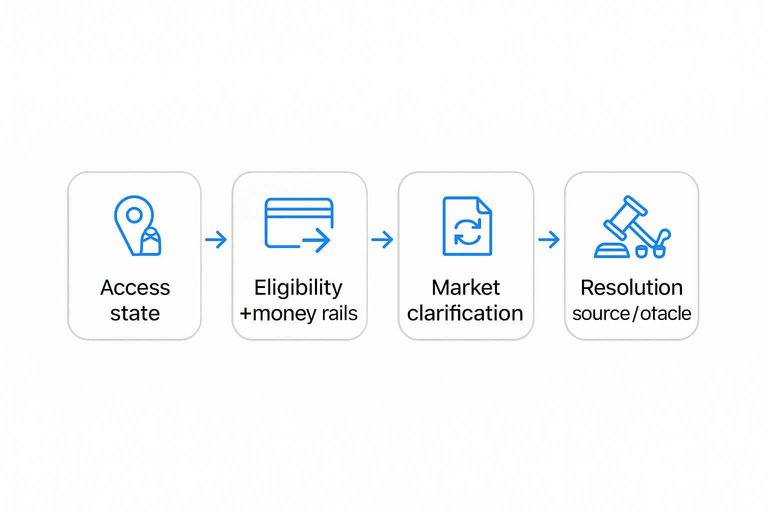
Rules and access risks
Non-price risks are where a “best” quote turns into an untradeable position. Treat these as hard filters before you trust any fifa world cup who will win market.
-
Access state (geo-restricted / close-only). Geo‑restricted / close‑only means you may be able to view a market and close existing positions, but you’re blocked from opening new ones due to location rules. Don’t guess—some venues expose state flags like acceptingOrders, enableOrderBook, and a restricted boolean right on the market object. One major venue also explicitly bans VPN-style workarounds and lists 39 countries as completely restricted; if you’re in that blast radius, price is irrelevant.
-
Eligibility + money rails (can you move capital when you need to?). If your venue charges up to a 2% fee on card deposits, that’s an immediate drag on “cheap” entry. If wire withdrawals aren’t supported below $500,000, that’s a real constraint on how you size positions and how quickly you can redeploy capital after settlement.
-
Market clarification (structural breaks). Market clarification means a rules update to the contract text or settlement criteria. On Polymarket, clarifications can clear the order book and cancel resting orders—so your liquidity vanishes and any pre-clarification price/flow data stops being comparable.
-
Resolution source / oracle + dispute mechanics. Resolution source / oracle means the mechanism and evidence used to finalize the outcome. On Polymarket, resolutions run through UMA’s Optimistic Oracle, where a proposed outcome can be disputed during a 2-hour challenge window. Practitioners don’t all price that the same way: one camp treats resolution as basically mechanical for mainstream sports outcomes if the rules are clear; the other discounts markets that can be disputed/escalated—especially if they can’t monitor the dispute window or the contract wording is ambiguous.
-
Settlement timing + auditability. If you rely on venue APIs to reconcile fills and model “what happened,” watch for systems that split data into live vs historical tiers with moving cutoff timestamps (retrievable via an endpoint like GET /historical/cutoff). A market you can’t reliably audit after the fact is a market you can’t confidently scale.
Apply it to 2026
Treat “World Cup winner” as a live execution problem, not a narrative. Your repeatable workflow is: take one timestamped snapshot per venue, score it on the same 11 metrics, then re-rank when the tournament state changes.
Pre vs post final
Mid‑tournament, weight the execution rows hardest: fee‑adjusted spread, near‑touch depth, depth a few cents out, and trade recency. That’s when you’ll most often find the rankings flip—because the “best” headline price is meaningless if it’s not fillable.
As you approach settlement, shift weight toward operational closure. Use FIFA’s final on July 19, 2026 as the anchor: after that point, your practical questions become “Can I still act in this market?” and “Can I audit what happened?” On Polymarket, check the market’s state fields (including acceptingOrders, enableOrderBook, and whether it’s restricted). If you’re in the United States, you’re blocked—and Polymarket explicitly prohibits using VPNs or similar tools to bypass geo restrictions—so a late move is dead on arrival.
Also plan your post‑mortem. If you’re pulling fills and depth history from Kalshi to see which venue was actually tradable, remember Kalshi partitions records into live vs historical tiers and the cutoff moves over time (via GET /historical/cutoff). That’s how you avoid “backtesting” on incomplete data.
Use MarketsPrediction
- Filter to the World Cup 2026 winner event and scan the cross‑platform implied odds alongside Volume (24 h) and Total Liquidity, then note the page’s “Last updated” timestamp.
- Use that scan to pick 2–3 venues to inspect deeper; don’t decide from the aggregator view alone.
- Click through and verify each venue’s market state (open/closed, accepting orders) and rules text.
- Open the order book on the venue itself (or via the Polymarket CLOB and Gamma APIs if you’re scripting) and score depth at the touch and within a few cents.
- Recompute “cheap” names with fees in mind—Kalshi’s fee table includes $0.07 in trading fees for 100 contracts priced at $0.01, which can reshuffle longshot rankings once you price entry/exit drag.
If you only do one thing: re-rank twice—once for tradability midstream, and once for settlement/access after the final whistle.
Informed judgment
In a winner market, the “most likely to win” team is the one with the highest post-fee executable probability on a venue you can actually access and trade at size—not the prettiest headline price.
So your first call is mechanical: rank teams by executable price after you price the round-trip, then refuse to anoint a favorite if the book is thin or stale. The “Is the US likely to win the World Cup?” sanity-check is the same: read the post-fee executable range for Team USA on the venue you can access; if the price is meaningfully worse than the top tier and the near-touch depth is light, you’re looking at fan demand, not an edge.
Venue choice comes next. Practitioners disagree on price discovery in high-attention events: one view is that Polymarket tends to lead when trading activity and liquidity are high; the counter is that for U.S.-based sports attention, Kalshi can dominate execution-relevant liquidity (and therefore the price that matters for “where can I actually get filled”) because it’s broadly accessible domestically while Polymarket applies extensive geographic restrictions.
On Polymarket, verify the market is tradable in the market object (fields like acceptingOrders, enableOrderBook, and restricted), and use the market’s conditionId (and its Gamma ID/slug) so your snapshots don’t mix similarly named markets.
Treat “AI predictions” as narrative; the tradable prediction is the order book you can hit today, then re-score at your next snapshot.
Q&A: Is the US likely to win the World Cup?
Q: Is the US likely to win the World Cup?
A: In this framework, the only defensible answer is: Team USA is “likely” to win only if it’s trading at the highest post-fee executable probability on a venue you can access, at the timestamp you checked. Anything else (roster talk, home-soil narratives, pundit picks) is commentary, not a tradable forecast.
Q: What should I look at right now to answer it mechanically?
A: Pull the best bid/best ask for Team USA in the winner market, convert that to an implied probability range, and then re-rank after round-trip fees. If you’re using Polymarket data, don’t answer from a screenshot: first confirm the market is actually tradable via the state flags (e.g., acceptingOrders, enableOrderBook, and whether it’s restricted) and anchor your snapshot to the correct conditionId so you don’t mix similarly named markets.
Q: What would make “US likely” a bad conclusion even if the headline price looks high?
A: Two common failures:
- The quote is not executable at size (thin near-touch depth), so the “probability” collapses the moment you try to buy.
- You’re looking at the wrong venue for your situation (e.g., a market that is geo-restricted for U.S. users). Polymarket explicitly lists the United States as blocked and prohibits VPN workarounds, so for a U.S.-based trader the actionable price has to come from an accessible venue, not the prettiest number on the internet.
Q: So what’s the clean takeaway?
A: Treat “Is the US likely to win?” as a price-and-execution question: at your timestamp, on your accessible venue, does Team USA have the top post-fee executable probability and enough depth to trade? If not, the market is telling you “not the favorite you can actually buy.”
Trade the executable price
The “best” World Cup winner price is the one you can actually hit: a post-fee executable quote on a contract that matches, on a venue you can access, with enough real depth and recent prints to take size without getting punished. If you treat volume or a pretty implied probability as the answer, you’ll keep buying phantom tightness, stale books, or rule risk you didn’t price. Your next move is simple: take one timestamped snapshot per venue, normalize the contract, compute fee-adjusted spread from the live bid/ask, and only then let depth, recency, and access flags decide where you trade. Use an aggregator view to narrow the field fast, but don’t pick a winner market until the venue’s order book and rules text survive the rubric.
Frequently Asked Questions
- Which team is most likely to win the FIFA World Cup in 2026, according to prediction markets?
- The market’s current favorite is the team with the highest executable YES price on a tradable “wins FIFA World Cup 2026” winner contract. Don’t use a headline odds table—use the best ask (to buy now) or best bid (to sell now) and confirm the market is actually open for new orders.
- Is the US likely to win the World Cup in 2026 based on market odds?
- Check Team USA’s current bid/ask on a World Cup 2026 winner market you can access, then compare its post-fee executable price to the top teams’ post-fee executable prices. If the spread is wide or depth is thin at the touch, the quote is a weak signal for “likelihood” because it’s not easily tradable.
- Where do I find the exact Polymarket World Cup winner market (so I don’t compare the wrong contract)?
- Use the Polymarket Market Details fields to pin the listing by conditionId (and keep the Gamma ID/slug consistent with the link you’re quoting). Before trusting the price, confirm the market state flags (including acceptingOrders, enableOrderBook, and restricted) show it’s actually tradable for you.
- Why does the same “fifa world cup who will win” probability differ across Kalshi, Polymarket, and other platforms?
- You’re often looking at different executable quotes (different bid/ask spreads and depth), not a disagreement about the match outcome. Even when the headline question looks identical, market state (acceptingOrders/closed) and restrictions can make one venue’s price real and another venue’s price effectively unusable.
- What’s the fastest way to compare World Cup 2026 winner odds across platforms without opening five tabs?
- Use MarketsPrediction to scan the same event across platforms in one view, then click through to the 2–3 venues with the best-looking liquidity to verify the live order book and rules. Treat the aggregator view as a shortlist tool, not the final execution check.