
 Best Platforms
 Live Odds








How South Carolina Primary Results Work: Advanced Counting Nuances
A pillar guide to understanding South Carolina primary results as they’re counted and reported—trace the election-night pipeline, compare ballot-type timing, unpack tabulation and adjudication architecture, and interpret vote shifts through canvass, audits, and feed-level reporting differences.
Watching South Carolina primary results roll in can feel like the numbers are changing “out of order.” One county updates twice in ten minutes, another goes silent for an hour, and suddenly a candidate’s margin narrows even though most precincts are reporting.
If you’re trying to analyze results responsibly, you need more than a percent-in chart. This guide walks you through how data moves from polling places to public dashboards, how different ballot types land at different times, what canvass and certification actually correct, and how to read late shifts without guessing.
Result Pipeline Map
Election results are a pipeline, not a single number. Raw ballots move through machines, people, and rules before they become official totals. The nuances hide at the handoffs.
Election-night phases
Election night is about publishing fast, not finishing. The canvass and certification are about proving the count is complete and lawful.
Unofficial reporting:
- Builds from precinct uploads and early/absentee batches
- Can contain reporting errors or missing batches
- Usually excludes some provisionals and late-arriving mail
Canvass:
- Reconciles ballots issued, cast, and counted
- Fixes duplications, tabulator issues, and human data entry errors
- Adds eligible provisionals and accepted late mail under rules
Certification:
- Final legal sign-off by the proper authority
- Locks the totals for contests and recount triggers
- Creates the record used for officeholder seating
If you want “truth,” follow the phase, not the headline number.
Data sources flow
Different ballot types enter the count through different doors. Each door has its own safeguards and failure modes.
- Precinct scanners produce election-day tabulator totals.
- Early voting generates separate device and memory uploads.
- Absentee-by-mail moves through verification, then tabulation batches.
- Provisional ballots sit out until eligibility is confirmed.
- Duplicate-record checks prevent double-counting across systems.
When totals jump, you’re often seeing a door open, not votes “found.”
Who publishes what
Counties run the election on the ground. The state aggregates county submissions, while media organizations model results for calling races.
County election boards:
- Post precinct-level and batch-level unofficial results
- Correct obvious reporting mistakes as they’re discovered
- Provide the source data the state compiles
State election authority:
- Aggregates county files into a statewide view
- Applies validation rules and standardized formats
- Publishes official results after the legal process completes
Media and AP-style calls:
- Combine official feeds with their own checks and projections
- May call races before all votes are reported
- Can diverge from government sites due to timing and labeling
If two screens disagree, ask who owns the data and who is estimating.
Update cadence quirks
Reporting is lumpy because election systems upload in batches. Gaps can be boring operational timing, not missing ballots.
- Batch uploads drop many precincts at once.
- “Zero tapes” show no votes before polls open.
- Late precincts can lag from staffing or connectivity.
- Results pauses happen during file validation checks.
- Partial batches post while others wait for sign-off.
A flat line on the graph often means “no upload,” not “no votes.”
Change windows
Most legitimate changes happen during the canvass, not on election night. That’s when officials reconcile paperwork, adjudicate edge cases, and apply eligibility rules.
Common canvass adjustments:
- Duplication fixes when a voter’s record appears twice
- Adjudication of ballots needing human review under rules
- Provisional eligibility determinations and subsequent tabulation
- Acceptance or rejection of late-arriving absentee ballots, if allowed
Watch the canvass agenda and logs. That’s where the real corrections live.
Ballot Types Interactions
Different ballot channels don’t just change convenience. They change when votes legally enter the count, and how totals reconcile without duplicates.
Election-night movement often reflects process gates, not persuasion. Watch the rules, not the rollercoaster.
Early vote reporting
Early in-person ballots are usually tabulated on election systems before polls close. Results are often embargoed, so they sit unseen until a legal release time.
That creates the classic “early dump,” where a big block appears at once. It’s not a surge of new votes. It’s an information release.
If a candidate is strong with early voters, the first wave can look like momentum. It’s just the first door opening.
Absentee-by-mail timing
Mail ballots move through multiple timestamps: sent, received, accepted, and counted. States also differ on receipt versus postmark rules, which changes which late-arriving envelopes are even eligible.
Curing adds another delay. A ballot can be “in hand” but not accepted until a signature or ID issue is fixed.
Late shifts can happen with zero new voting. You’re watching acceptance catch up to receipt.
Provisional resolution
Provisional ballots exist because eligibility is uncertain at check-in. They are reviewed later, with documentation and voter history.
- Name not found in pollbook
- ID or eligibility question
- Wrong precinct or ballot style
- Already marked as voted
- Registration status mismatch
Provisional voters are a different slice of the electorate. That’s why their acceptance rate and candidate mix often diverge.
Spoiled and reissued
Spoiled ballots happen when a voter makes an error and requests a new ballot. The key control is linkage: the old ballot is voided, the new one is issued, and the check-in record shows one voter path.
Replacement workflows also guard against cross-channel collisions. If someone requests a mail replacement, election systems flag the original so only one can be counted.
The log is the truth source. Totals are just the output.
UOCAVA edge cases
Military and overseas ballots run on different logistics. Delivery, return, and verification can stretch past what most people think of as “election night.”
- Late arrival within legal window
- Different return methods allowed
- Missing witness or signature fields
- Jurisdiction-specific acceptance tests
- Extra time for cure or review
In a close margin, these ballots can matter because they clear later. The count moves when the pipeline clears.
Tabulation Architecture
Counting in South Carolina is a system, not a single machine. Some parts are fully automated, others are human-mediated, and both leave records.
Adjudication is where humans touch the count without changing the underlying rules of voter intent. If you want to understand “why totals moved,” follow the workflow, not the headline.
Scanner vs central count
Precinct scanners usually produce unofficial totals quickly because ballots are read close to where they’re cast. Central count workflows, especially for absentee, trade speed for controlled processing and tighter batching.
On Election Day, in-precinct scanning creates rapid subtotal reporting by polling place or scanner unit. Absentee and other centrally processed ballots often move through opening, verification, duplication when needed, then scanning in larger batches. Reconciliation happens on different clocks, because precinct scanners and central count operations close and report at different times.
If results lag, it often reflects workflow sequencing, not missing votes.
Ballot style mapping
Ballot style mapping ensures each voter sees and is counted for the contests they’re eligible to vote in. When it’s wrong, you can count perfectly and still count the wrong thing.
Election programming ties precincts, districts, and party rules to specific ballot styles. That mapping drives what the scanner expects and how it interprets target positions. Misprints, style swaps, or incorrect programming can surface as unusual undervote patterns or contest totals that don’t reconcile to issued styles.
Remediation is less about “fixing totals” and more about proving which style each ballot actually was.
Adjudication rules
Adjudication handles ballots the scanner flags as ambiguous, while staying inside voter intent rules. The key is consistency, plus a durable record of every decision.
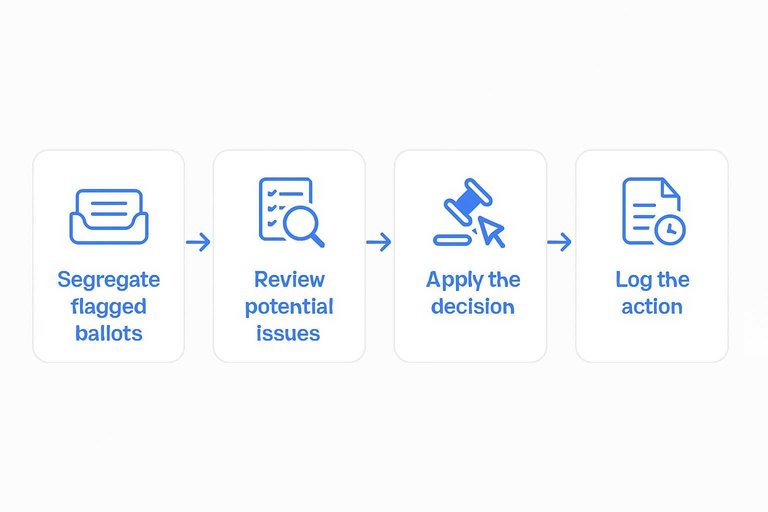
- Segregate flagged ballots into an adjudication queue with batch and ballot identifiers.
- Review potential issues like overvotes, marginal marks, and write-in legibility per policy.
- Apply the decision in the adjudication system, preserving the original capture image where available.
- Log the action with reviewer identity, timestamp, and the specific contest affected.
- Export adjudication reports for canvass and retain them with election records.
If you can’t reconstruct the decision trail, the dispute becomes about process, not marks.
Chain-of-custody logs
Chain-of-custody logs show who had what, when, and in what condition. They matter most when someone claims ballots were added, removed, or swapped.
- Seal numbers for containers, with open/close times
- Batch manifests listing counts and identifiers
- Memory media custody records and transfer signatures
- Access logs for secure rooms and tabulation workstations
- Exception logs for broken seals or re-sealing events
When totals are challenged, these logs turn suspicion into something testable.
Duplicate detection
Duplicate detection prevents a single voter’s ballot from being counted twice across mail, early voting, and Election Day. It’s mostly administrative matching, but it shows up in totals.
Election offices compare voter credit and ballot status across systems to catch cases like a returned absentee ballot plus an in-person vote. When a duplicate is resolved, one ballot is accepted and the other is rejected or marked not countable, depending on timing and rules. In canvass reporting, these removals can appear as adjustments that reduce a prior subtotal, even though no one “took votes away” after counting.
If you see a negative adjustment, look for a resolved duplicate or a corrected ballot status.
Canvass and Certification
Election night totals are operational totals. They move fast, and they can be messy.
The canvass is where South Carolina reconciles people, paper, and machine outputs into one official record. That’s the line between reporting and results.
Reconciliation checklist
Reconciliation is where your county proves the numbers balance. It protects against both innocent mistakes and quiet process drift.
- Compare check-ins to ballots cast per precinct and voting method.
- Account for every spoiled ballot and every replacement ballot issued.
- Reconcile provisional ballot counts, including accepted and rejected totals.
- Validate absentee-by-mail totals against ballot receipt and acceptance logs.
- Flag precinct anomalies, then resolve with documented source records.
If the books don’t balance, nothing else downstream deserves trust.
Audit touchpoints
Audits start before polls open and continue after results post. They don’t “find votes.” They verify the system counted what voters marked.
Common touchpoints include logic and accuracy testing, post-election audit procedures, and recount triggers or requests under state rules.
Treat audits as controls on process, not opinions about outcomes.
Error correction paths
Corrections fix reporting artifacts, not voter intent. The key is distinguishing a display problem from a tabulation problem.
- Re-scan a ballot only under documented, authorized procedures.
- Correct precinct assignment in reporting systems, not in cast vote records.
- Re-export results after fixing configuration or upload errors.
- Amend unofficial reports while preserving original logs.
- Escalate suspected tabulation issues into audit and recount channels.
If you can’t explain the correction path in writing, you shouldn’t ship the correction.
Certification artifacts
Certification is paperwork plus provenance. It’s the point where specific documents become the authoritative source.
Expect to see canvass reports, precinct returns, audit logs, and certified results files treated as the record of truth.
Once certified, the question shifts from “what happened” to “what’s the documented basis.”
Interpreting Vote Shifts
Margins move because the remaining votes are rarely a random sample. They arrive in batches tied to place, method, and processing steps, so the mix changes.
Imagine a candidate leading early on in-person votes, then shrinking as absentee batches post. That’s usually logistics plus geography, not magic.
Batch composition
“Late” reporting usually means a different channel or workflow stage, not slower humans. Channels cluster by geography, voter habit, and administrative capacity, so each batch has a signature.
Election night batches often map to:
- In-person precinct scanners that upload quickly
- Central-count absentee batches posted in waves
- Early vote sites with their own reporting cadence
- Smaller precincts finishing sooner than large ones
If the outstanding pile leans urban, campus-adjacent, coastal, or rural, the margin can drift predictably. Track the mix, not the clock.
Outstanding vote math
You can bound how far the margin can still move using what’s unreported and how it usually breaks. You’re building a range, not a prophecy.
- List what’s truly outstanding: unreported precincts, unposted batches, and acceptance backlogs.
- Estimate the maximum net swing if remaining votes mirror each area’s past split.
- Apply a conservative haircut for likely rejections and duplicates, by ballot type.
- Recompute a best-case and worst-case scenario for each candidate.
- Update the range only when the outstanding categories shrink or change composition.
If your “needs” number exceeds the plausible range, the race is functionally decided even before every ballot posts.
Negative adjustments
Totals can go down because election reporting is also error-correction. Some fixes are mechanical, and they can hit either candidate.
- Duplicate records removed after matching
- Precinct tallies corrected after reconciliation
- Adjudication decisions reversed on review
- Batch uploads replaced with corrected files
- Provisional ballots rejected after verification
A drop isn’t a smoking gun by itself. It’s usually the system balancing its books.
Close-margin playbook
In a tight race, your focus shifts from “who’s ahead” to “what categories can still change.” The actionable questions are about eligibility, deadlines, and recount triggers.
Watch these buckets and moments:
- Provisional ballots: volume, reasons, and verification pace
- UOCAVA ballots: when they’re received and counted
- Cure processes: signature or ID issues, and their deadlines
- Recount thresholds: automatic versus requested rules
- Litigation timing: injunctions often target counting windows
The tell is not drama on TV. It’s whether remaining categories are large enough, and legally stable enough, to move the margin.
Reporting Feeds Differences
Different feeds are built for different jobs. That choice changes what gets included, when it shows up, and how corrections appear.
| Feed type | Primary purpose | What it includes | Common mismatch trigger |
|---|---|---|---|
| Election night website feed | Public display | Latest posted totals | Late precinct uploads |
| County EMS export | Local operations | Precinct and batch detail | Provisional held back |
| State aggregation feed | Statewide rollup | Standardized county totals | County reclassifies ballots |
| Media/API partner feed | Fast distribution | Cached, normalized numbers | Cache lag or dedupe |
If two feeds disagree, check their update clock and ballot scope before you argue about “accuracy.”
How traders should read corrections, precinct coverage, and batch updates
If you trade on election-night moves, the most useful mental model is that feeds can be “right” at different times because they’re publishing different states of the count. When you see feed-to-feed differences, map them to a reporting artifact before you treat it as alpha.
-
Corrections (downward or sideways revisions): A drop in totals or a candidate losing votes usually means the source re-labeled a bucket (e.g., a batch moved from Election Day to another category) or fixed a duplicate/entry error. Traders should sanity-check by comparing net change across candidates (does the total votes cast change, or is it a reshuffle?) and by waiting for the same correction to propagate to at least one other feed before assuming fraud or a “recount.”
-
Precinct coverage gaps (e.g., “80% precincts reporting” but totals don’t match): “Percent in” can be based on precincts that have posted any results, not precincts that are fully reported, and some feeds compute it differently. Interpret it as a coverage indicator, not a completion guarantee. A quick check is whether the feed is updating vote totals without changing precincts-in (often batch uploads into already-reporting precincts).
-
Batch updates and cache lag: County EMS and state rollups often update in bursts; media/API feeds may smooth or delay those bursts due to caching, normalization, or deduping. If one feed jumps and another stays flat, treat the flat one as potentially stale until its “last updated” clock advances. For trading, it’s safer to key off time-stamped freshness and the direction of subsequent prints than to assume the first mover is “more accurate.”
Practical rule: before you fade or chase a move, reconcile (1) update time, (2) ballot scope included, and (3) whether the change is a true net add vs. a reclassification. That simple checklist catches most election-night “arb” that’s really just feed mechanics.
Common Misread Signals
Early South Carolina primary returns can look like a trend line when they’re really a process artifact. If you model or live-blog, these are the signals that get misread most often.
- Treating first dumps as representative precinct mix
- Assuming absentee equals “early” reporting everywhere
- Reading county order as vote swing, not file timing
- Over-weighting tiny precincts with 100% reporting
- Inferring momentum from batch size changes
Misread two or more of these at once, and you’re not analyzing votes. You’re analyzing plumbing.
Analyst Checklist
You can get the math right and still publish the wrong story. Use this checklist before you call trends or hint at irregularities.
- Confirm the data source, timestamp, and update cadence before comparing snapshots.
- Verify what the unit is: precinct, county, vote center, or absentee batch.
- Reconcile totals across views: candidate totals, turnout totals, and reported precincts.
- Check whether late-arriving categories exist: absentee-by-mail, provisional, cured ballots.
- Stress-test your narrative by asking what normal operations could explain the pattern.
If your claim survives all five, you can publish it without hand-waving.
Read the Next Update Like an Auditor
- Identify the update source and phase: election-night unofficial vs post-election canvass, and whether you’re viewing county releases, the state portal, or media/AP feeds.
- Classify what likely moved: election-day precinct batches, early vote uploads, absentee-by-mail additions, provisional resolutions, or adjudication-driven adjustments.
- Sanity-check the math: compare raw vote deltas by contest, watch for negative adjustments tied to duplication/spoiled reissues, and recalc margins using “outstanding vote” assumptions that match the batch composition.
- Confirm with artifacts: look for reconciliation notes, chain-of-custody logs, canvass reports, and certification documents before treating a swing as final.
Frequently Asked Questions
- Why do primary results in South Carolina sometimes differ between county websites, the SC State Election Commission, and the AP feed?
- They’re often pulling from different reporting systems and update schedules, so each source can be “right” for its timestamp. To reconcile, match the last-updated time and compare which precincts or absentee batches are included in each feed.
- Are South Carolina primary results official on election night, or can they change afterward?
- Election-night numbers are usually unofficial and can change during canvass and certification as late-arriving eligible ballots are added and reconciliation fixes reporting artifacts. The official results are the certified totals published after post-election checks are complete.
- How can I tell whether a South Carolina primary vote shift is normal reporting flow or a real counting issue?
- Check whether the shift aligns with a new batch type (absentee-by-mail, early voting, election-day precincts) and whether turnout/precinct completeness moved at the same time. If the margin changes without any added precincts or batch volume, verify you’re not mixing sources or viewing a feed correction.
- Do I need precinct-level data to analyze primary results South Carolina accurately, or are statewide totals enough?
- Statewide totals are fine for headline tracking, but precinct-level (or at least county-level) data is usually needed to explain shifts and validate completeness. Use precinct reporting status plus batch notes to avoid over-interpreting partial returns.
- What’s the best way to track “outstanding votes” in South Carolina primary results when sites don’t show it directly?
- Use the number of precincts reporting plus known ballot channels (early/absentee vs election-day) to infer what’s likely still missing, and cross-check against historical turnout or issued/returned ballot reporting if available. The key is to estimate what categories remain, not just how many raw votes are left.