
 Best Platforms
 Live Odds








President market limitations in 2026: how to audit election contracts
Audit a 2026 president market: legality, payout terms, settlement/review, fees/liquidity, and why price isn’t probability—plus a checklist.
You’re looking at a market price on who will win the next presidential election and wondering whether to trade it—or trust it as a forecast. The risk is treating a clean-looking percentage as reality, then getting stuck in a contract you can’t legally access, can’t size properly, or can’t exit when the story changes.
This collection breaks down the most common limitations that trip people up: what the contract actually pays on, how settlement can lag (or get reviewed), how fees and thin liquidity skew “odds,” and when a price should be read as sentiment instead of probability—ending with a step-by-step audit checklist.
Access & legality
Before you read anything into a president market price, answer the boring question: can you legally and practically trade this contract on this venue from where you are?
-
Jurisdiction blocks (you may be locked out entirely). Polymarket’s geographic restrictions state that U.S. traders and others in restricted jurisdictions are prohibited from trading on Polymarket International.
-
Practical account model (you may not be set up to trade). That same Trust & Safety documentation describes Polymarket International as non-custodial: users hold their own private keys, and collateral backing an open position sits in a smart contract (not with Polymarket). If you can’t operate under that model, the contract may be “available” in theory but not actionable for you.
-
U.S. regulatory posture (the market can become non-actionable). On February 4, 2026, the CFTC announced it had withdrawn its June 10, 2024 proposed rulemaking titled “Event Contracts” and said it did not intend to issue final rules for that proposal. In the Commission’s May 10, 2024 approved voting copy for that proposal, it also stated it would consider an event contract to “involve” gaming if it is premised on the outcome of one or more political contests, and that political-contest contracts involving staking something of value on an election outcome would be considered to involve activity that is unlawful under state law under CEA section 5c©(5)© and 17 CFR 40.11.
If you can’t clear these hurdles, the “best” price is just a number you can’t use.
Contract defines reality
An event contract—a derivatives-style contract that pays a fixed amount (often $1) if a defined event/outcome occurs and $0 otherwise—doesn’t settle on the headline. It settles on the payout criterion (the binding condition in the terms), using whatever source agency / designated media sources (the named official documents or media callers) the contract designates.
-
The headline question is not the instrument. A “who wins?” president market can be written to measure a narrow legal artifact, like which candidate/party appears on states’ certificates of ascertainment (the formal documents certifying a state’s presidential electors) as of Congress’s post‑election joint session.
-
The contract can hard-code a tie-breaker you didn’t expect. In one Kalshi presidential product, if multiple certificates are sent, the one Congress counts is the one the contract uses—so the “real outcome” for payout purposes is “what Congress counted,” not your preferred narrative of the election.
-
Edge-case timing can flip the result. The same product says that if no official certificate of ascertainment exists by the contract’s Expiration Date, the market resolves to No—even if everyone “knows” who won.
-
Acceleration clauses can redefine ‘won’ as ‘called.’ Kalshi’s elections rules allow resolution on an accelerated basis for some U.S. elections once at least 4 of 8 named Designated Media Sources have declared a winner and none has issued a contradictory declaration.
-
Even the source list can be mutable. Those rules also allow a Designated Media Source to be replaced at the exchange’s sole discretion if it stops providing independent election calls.
If you don’t separate the headline from the payout criterion, you’re not trading “the presidency”—you’re trading the contract’s paperwork.
Settlement isn’t instant
A president market trade doesn’t “cash out” when the news cycle feels done. Settlement is a rules process, and the path can include early calls, discretionary review, and formal dispute windows.
-
Limitation 6: Accelerated media-call settlement can be fast—and reversible in practice. Accelerated resolution (a clause that allows settlement before final official certification if specified media sources have declared a winner and no contradictions exist) is designed to pay out sooner. The catch is that “called” is not the same thing as the contract’s final documentary proof, so traders can end up holding exposure through the gap between a media consensus and the paper trail the contract ultimately cares about. If you’re pricing a position, treat “time-to-cash” as part of the bet, not an afterthought.
-
Limitation 7: Review and oracle challenges can stretch the finish line. A Market Outcome Review (a venue’s formal process to review/adjust a market outcome before settlement when the rules don’t map cleanly to the facts) introduces discretion and clock time precisely when things are messy.
-
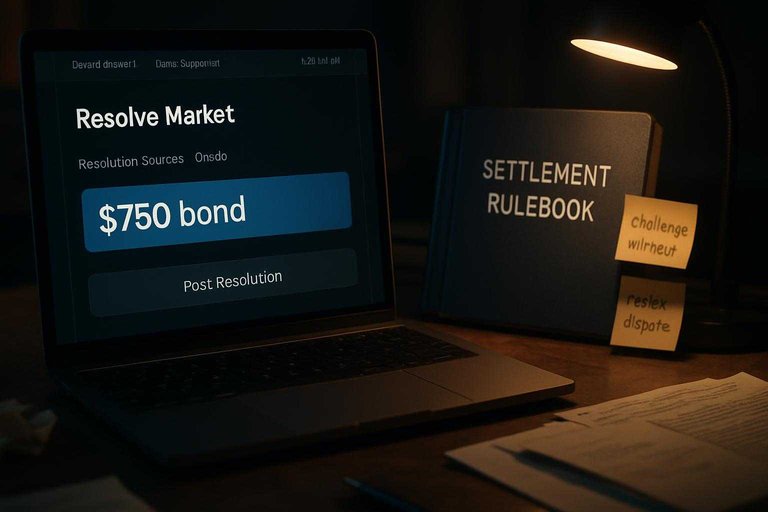
On Polymarket, markets resolve through the UMA Optimistic Oracle (a smart-contract oracle where an outcome is proposed and becomes final unless disputed during a defined challenge window). Proposing a resolution requires posting a $750 bond that can be forfeited if the proposal is unsuccessful, and once proposed the market enters a 2-hour challenge period where the outcome can be disputed.
-
If a dispute happens, it escalates into UMA’s dispute process (via the UMA Data Verification Mechanism), which means your “won” position can still be tied up while the system decides what “won” means under the rules.
When you see a tight election contract, you’re also seeing a settlement workflow with failure modes—not an instant, objective payout.
Fees, limits, liquidity: why “odds shopping” breaks
Displayed odds aren’t a universal quote. Once fees, rounding, maker/taker rules, and position limits differ by venue, the “best” president market price can be the one you can’t actually trade at size.
-
Fee curves can flip the best venue at different prices. On Polymarket, the Politics-category taker fee rate is 0.04, applied using the common event-contract shape fee = C × feeRate × p × (1 − p), which means the fee changes with the displayed price, not just your size.
-
Maker/taker rules change who pays. A taker order immediately matches existing liquidity; a maker order posts resting liquidity that another trader later hits. Polymarket states makers are never charged fees and takers pay a fee on certain markets—so a “better” price that requires you to take may be worse after costs.
-
Rounding kills tiny arbitrages. Kalshi’s fee schedule uses a taker-fee coefficient 0.07 inside a rounding step: fees = round up(M × 0.07 × C × P × (1 − P)). If the fee rounds up, the last cent (or the last few contracts) can turn an apparent edge into a loss.
-
Position limits cap expression and hedging. A position limit is a cap on how large a position a participant can hold in a specific contract/strike, limiting maximum exposure and sometimes hedging utility. In Kalshi’s PRESPARTYSTATE $1 terms, the limit is $3,000,000 per strike, per Member for Individuals and Entities.
-
Liquidity fragments by venue, so the “best price” may be only for the first fill. When depth is split across platforms, you can’t assume you can complete the whole trade near the top-of-book quote.
The practical test: compare venues on net price after fees, the order type you must use, and whether limits let you hold (or hedge) the position you actually want.
Price ≠ probability
A president market price is a tradable clearing price, not a calibrated forecast. People read “X¢ = X%,” but that interpretation quietly assumes away real frictions: traders have different beliefs, different budgets, and different willingness to hold risk (risk aversion—preferring a smaller sure gain over a bigger uncertain one). A Federal Reserve Bank of San Francisco working paper frames this directly: treating prediction-market prices as literal probabilities needs assumptions about preferences, budgets, and belief dispersion, and those assumptions can fail.
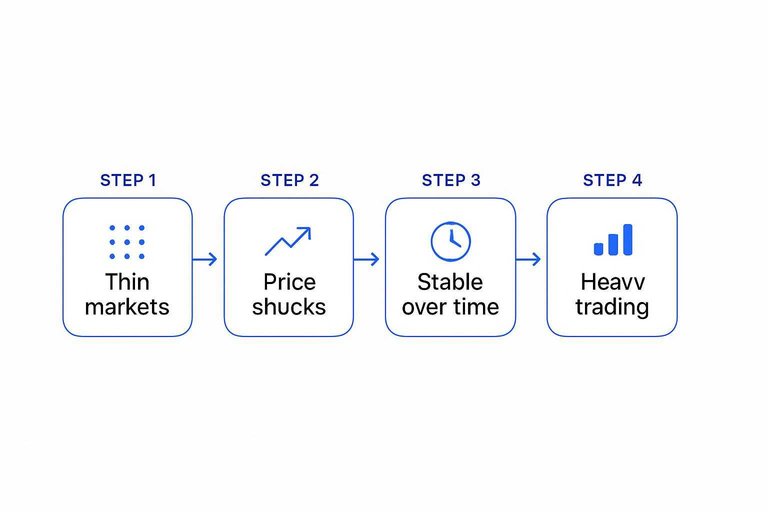
Thin markets—low participation and low depth—make the gap bigger, because a motivated flow can move the quote even if it doesn’t represent consensus. A 2025 arXiv field experiment that randomly “shocked” prices across 817 markets found manipulation is possible, and the effects of those trades were still visible 60 days later; it also reports that more-traded markets were harder to manipulate.
How to use this in practice: trust price more when it’s stable across time and supported by heavy trading; treat it more like sentiment/positioning when it jumps on little activity or looks “pushed” in a low-volume window.
Audit checklist
-
Actionability (can you trade it?)
Confirm you’re allowed on the venue from where you are, and that the contract isn’t restricted to a trader category you fall into. On Polymarket International, for example, U.S. traders and users in restricted jurisdictions are prohibited from trading. If you can’t place/hold/exit orders, the page is just commentary. -
Instrument check (what does it actually measure?)
Open the rules and locate the exact outcome statement, the settlement trigger, and the named sources/documents used to decide it. If the terms don’t match the headline you think you’re trading, stop. -
Resolution path (how does “Yes/No” become final?)
Identify whether it can resolve early (media calls), whether there’s discretionary review, and what dispute mechanism applies. Price in “time-to-cash,” not just direction. -
Tradability (can you get size at the displayed price?)
Check depth, spreads, maker vs taker route, and any position limit that blocks your intended exposure or hedge. On Polymarket, makers are never charged fees while takers pay a small fee on certain markets—and some geopolitical/world-events markets are fee-free—so your route to liquidity can change the net price. -
Daily monitoring (5 minutes)
Re-check: (a) rule/terms edits, (b) source-list clarifications/replacements, © liquidity/volume regime shifts, (d) regulatory news—especially CFTC posture on political-contest event contracts under CEA section 5c©(5)© and 17 CFR 40.11, including the CFTC’s February 4, 2026 withdrawal of its 2024 “Event Contracts” proposal and the Commission’s stated view that political-contest event contracts can “involve” gaming and activity unlawful under state law under that framework.
Audit before you trust the price
A clean-looking “win %” isn’t the presidency—it’s a venue-specific event contract with legal access constraints, a written payout criterion, and a resolution process that can drag or be disputed right when things get messy. If you treat the headline as the instrument, ignore time-to-cash, or compare venues on displayed odds instead of net price after fees, order type, liquidity, and limits, you’re taking risks you didn’t mean to take. Do the audit checklist first, then decide what the quote is: a trade you can actually enter and exit under the rules, or just a sentiment signal that can be pushed around when activity is thin. Once you’re in, keep the five-minute daily monitor—especially for rule/source changes, liquidity shifts, and regulatory posture—so the contract you’re holding doesn’t quietly become a different bet.
Frequently Asked Questions
- In a president market, what does “win the presidency” actually settle on—Election Day results or the official paperwork?
- It settles on whatever the contract defines as the payout criterion, which can be a formal artifact like which candidate/party appears on a state’s certificate of ascertainment rather than the Election Day headline.
- Are president market election contracts “legal” in the U.S. in 2026, and who decides that?
- U.S. legality turns on the CFTC and the Commodity Exchange Act framework, including CEA section 5c(c)(5)(C) and the Special Rule in 17 CFR 40.11 that addresses certain event contracts tied to political contests.
- Is a media call (like Decision Desk HQ calling the race) the same thing as final settlement in a president market?
- No—some contracts can use designated media sources like Decision Desk HQ for accelerated resolution, but the binding trigger is still the contract’s written settlement rule, not the news narrative.
- What happens if a president market outcome is disputed on an oracle-based venue like Polymarket?
- A disputed outcome can escalate into the UMA Data Verification Mechanism (DVM), meaning resolution follows a formal dispute process instead of settling instantly when an outcome is proposed.
- Should I treat a president market the same on every platform, or do Kalshi and other venues have structurally different contract risk?
- Don’t treat them as interchangeable: a Designated Contract Market (DCM) like KalshiEX LLC operates under an exchange rulebook and contract specs that can differ materially from other venues’ settlement and review mechanics.