
 Best Platforms
 Live Odds








South Carolina Primary Results vs Exit Polls: Which Guides Trading?
A trader-focused comparison of South Carolina primary results versus exit polls—how each signal arrives, when speed beats certainty, where each breaks, and how to translate election-night information into clear decision rules across rates/FX, equities, and prediction markets.
On election night, the market doesn’t wait for perfect information—it reacts to the first narrative that feels tradable. That puts you in a familiar spot: do you lean on exit polls for the earliest signal, or wait for official primary results that come with more certainty?
This comparison breaks down what each source really measures, how timing and confidence trade off, the most common failure modes, and a practical framework for turning noisy headlines into disciplined, pre-planned trades across rates, FX, equities, and prediction markets.
What Each Source Is
Primary results and exit polls answer different questions, at different speeds. One measures counted votes; the other measures reported intentions, then gets corrected.
Primary results
Primary results are the official vote counts released by election authorities as precincts report. They arrive in chunks, because precincts finish at different times and some ballots take longer to process.
Early returns can be skewed by which precincts report first, plus how each county batches mail, early, and Election Day votes. “Called” means a race is projected by a decision desk using partial counts; “certified” means the jurisdiction has finalized and legally confirmed totals.
If you’re trading on results, treat “called” as probability and “certified” as closure.
Exit polls
Exit polls are surveys of voters, designed to estimate both who won and why. They combine in-person interviewing with other modes, then apply weighting to match expected turnout and known demographics.
Those weights can change as real turnout data arrives, so early numbers can swing even without any “new” voters being surveyed. Method tweaks, late-reporting groups, and sample composition can shift the headline fast.
Exit polls are a narrative feed first, and a measurement second.
Trading relevance
Primary results and exit polls move markets for different reasons. One reduces outcome uncertainty; the other reshapes the story investors think will follow.
- Primary results: confirm winners with rising certainty
- Primary results: reveal geographic strength and turnout patterns
- Exit polls: surface coalitions and issue salience
- Exit polls: hint at policy mandate narratives
- Exit polls: spark repositioning before counts settle
Trade them like different instruments: results for direction, polls for volatility.
Speed vs Certainty
Markets price elections like a live probability problem. The first usable signal moves prices, then better data compresses risk.
Traders care about two clocks. Speed. And certainty.
First signal wins
Exit polls often hit the tape before meaningful vote totals. Early liquidity reacts because a credible narrative reduces the number of plausible outcomes.
Imagine a thin overnight futures book. One clean exit-poll headline can shift positioning, even before any county reports.
Confirmation value
Partial results arrive later, but they test the story. Each batch of returns either supports the exit-poll framing or forces a fast repricing.
Watch the gap between the narrative and the count. When returns match expectations across multiple precinct types, probability ranges tighten and hedges get cheaper.
When timing flips
Results lead when the count becomes the earliest credible narrative. That happens under a few repeatable conditions:
- Fast-reporting precincts set the tone early
- Decisive margins reduce model sensitivity
- Clear geographic patterns confirm coalition shifts
- Low drama races limit interpretation risk
- Transparent reporting feeds boost confidence
In those nights, you trade the tape of returns, not the story around them. For context on how results are gathered and updated, see how AP counts the vote.
Where Each Breaks
Exit polls and live results fail in different ways. Your job is spotting the break early, before you price fiction.
Exit poll errors
Exit polls are fast, but they’re a modeled estimate. The model breaks in predictable places, especially early.
- Nonresponse clusters among high-intensity partisans
- Turnout model misses first-time surges
- Late deciders misreported or overfit
- Demographic weighting amplifies small sample quirks
- Mode effects shift answers by interview method
Treat exit polls as a direction finder, not a ruler.
Results distortions
Reported results are real votes, but they arrive in a biased order. The tape can lie midstream when the pipeline is skewed.
- Early precincts aren’t representative
- Mail and early batches drop in lumps
- Urban cores report differently than rural towns
- Provisional and cure ballots lag the headline
- County sequencing creates fake “momentum”
If the mix of reporting areas is changing, the story is changing too.
Reality checks
You need quick filters that work under time pressure. Use sanity tests that don’t require perfect data.
A simple checklist:
- Compare current margins to the last similar primary map.
- Watch margin stability as the vote share climbs.
- Match swings to geography, not vibes.
If the swing doesn’t map to reporting geography, it’s usually a mirage.
Tradable Signals Matrix
You need a fast rule for when to trust the count versus the survey. Use results for what happened, and exit polls for why it happened.
| Trading question | Better input | Why | What to do next |
|---|---|---|---|
| Who actually won? | Primary results | Verified vote count | Trade the confirmed leader |
| Will the margin widen? | Primary results | Remaining precinct math | Watch outstanding areas |
| Was turnout unusual? | Exit polls | Self-reported voting patterns | Size risk, not direction |
| Which blocs moved? | Exit polls | Demographic preference splits | Hedge related themes |
| Is there a surprise? | Primary results | Beats expectations | Reprice quickly, then reassess |
Pick one “winner” per question before you click buy or sell, or you’ll trade noise.
Platform-Aware Execution: When the Signal Becomes a Trade
The matrix tells you what to trust. Execution is where you trust it—because prediction-market pricing differs by platform, and “right idea, wrong venue” is a common way to lose.
1) Start with odds dispersion (is there even an edge?)
- If all platforms cluster tightly, you’re mostly paying fees/spread for little payoff. Prioritize the cleanest fills, not the “best narrative.”
- If platforms disagree, treat that as the setup: pick the venue that’s mispriced relative to the rest, then plan your exit on the venue that usually re-aligns fastest.
2) Pass a quick liquidity and volume screen (can you actually get in/out?)
Before clicking buy/sell, check:
- Depth / liquidity: Can you enter at your intended price without moving the market?
- Recent activity / volume: Are trades printing often enough that you can exit without waiting for a miracle?
- Spread: Wide spreads can erase the edge from a small “results vs exit poll” advantage.
If liquidity is thin, downsize or skip. A correct read is not a tradable signal if you can’t exit.
3) Timing checks: match the data cadence to the platform’s reaction time
- Primary results trades: Avoid guessing when updates are stale. Use the newest available results update and wait for confirmation when the tape is jumpy.
- Exit poll trades: Treat early cross-tabs as fragile. If pricing is already moving hard, wait for stabilization or use smaller probes rather than full size.
4) Convert the matrix into an order plan
- Confirmed leader (results-driven): Enter where odds lag across platforms; scale out as platforms converge.
- “Margin widening” (results + precinct math): Don’t market-buy into spikes; place limits and only add when the next results update supports your thesis.
- Turnout/bloc moves (exit polls): Use as risk sizing and hedging logic (related markets/themes), not as a standalone direction bet.
The goal: use the matrix to choose the right input, then use platform dispersion + liquidity + timing to choose the right trade.
Assets Most Sensitive
Some markets move on any hint of a political edge. Others wait for counted votes because positioning risk is real.
Rates and FX
Rates and FX translate politics into a policy path and a risk-tone toggle. Exit polls can nudge expectations, but they carry sampling and turnout risk.
Imagine a close primary night with early survey chatter pointing one way. The front end of the curve and high-beta FX can twitch, yet those moves often fade when precincts report.
Confirmed results usually lead because they change the distribution of outcomes, not just the narrative.
Equities and sectors
Equities trade stories about regulation, procurement, and fiscal posture. Exit polls can spark fast thematic rotations, especially in policy-exposed sectors.
You’ll see the biggest sensitivity in baskets tied to headlines: defense, energy, healthcare, banks, and contractors. Results then act like a switch, because desks can justify bigger size once uncertainty collapses.
Trade the impulse on polls, but size the conviction on results.
Prediction markets
Prediction markets reprice in real time because probabilities are the product. Exit polls can move price briefly, but results dominate because settlement risk is binary.
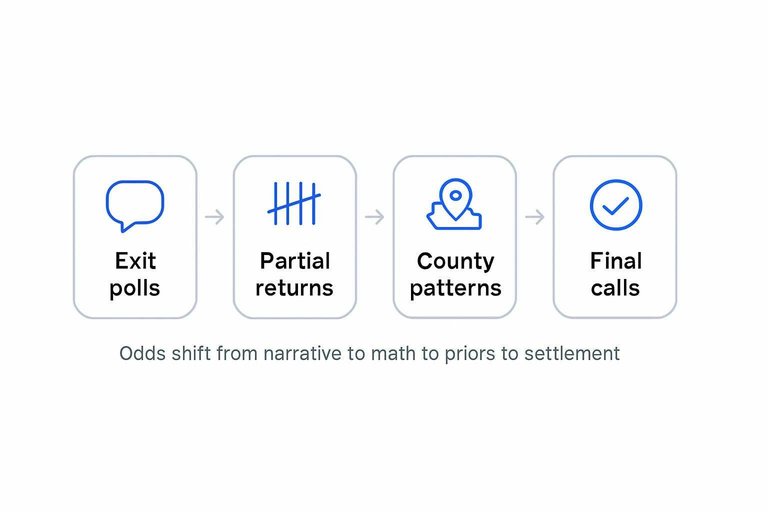
- Exit polls move odds on surprise narratives
- Partial returns move odds on math
- County patterns move odds on priors
- Final calls move odds on settlement
If you can’t settle it, you’re just trading mood.
Decision Rules for Traders
Exit polls are fast, noisy inputs. Results are slower, cleaner signals.
Your edge comes from pre-committing to rules, then executing without improvising when the tape gets jumpy.
Pre-event plan
You need a written plan before the first headline hits. It prevents “one more tweak” from becoming your whole strategy.
- Define your thesis in one sentence and the key variable to watch.
- Pick instruments that can express it cleanly, with acceptable spreads and liquidity.
- Set invalidation levels first, including the exact price where you exit.
- Write explicit triggers tied to poll deltas or margin thresholds in results.
- Pre-set order types and position caps for each trigger tier.
If you can’t predefine the exit, you don’t have a trade.
Exit poll playbook
Exit polls can move price before you can blink. Treat them like a spark, not a fire.
- Trade only when multiple exit poll measures point the same direction.
- Start with small size and add only after confirmation from another source.
- Check cross-tabs for coherence, especially turnout and subgroup shifts.
- Use tight, fast stops, and accept getting chopped once.
- Stop trading the poll when the market stops reacting to updates.
If the cross-tabs don’t make sense, assume the signal is wrong. (If you want a quick primer on methodology, see how the general election exit poll works.)
Results playbook
Results are your confirmation engine. They also create whipsaws when early precincts mislead.
Imagine early returns show a big lead, then the next reporting wave narrows it sharply. You wait for the margin to hold across two or more waves before scaling in.
Use liquidity windows right after major updates, not during thin, jumpy moments. Avoid chasing a “call” headline if price already repriced the outcome.
Your job is to trade the stabilization, not the surprise.
Post-mortem checklist
You only get better by auditing decisions, not outcomes. Write it down while it’s still uncomfortable.
- Record the signal you acted on.
- Timestamp your entry and exit.
- Note market reaction versus your expectation.
- Identify what information misled you.
- Update one rule for next time.
The fastest way to improve is to fix the rule that created the loss.
Common Misreads
Fast market moves tempt you to treat political numbers as price signals. Most trading mistakes come from reading the wrong number, too literally, too early.
- Treating early exit polls like vote totals (exit polls).
- Ignoring turnout composition shifts by county (results).
- Overweighting a single demographic crosstab (exit polls).
- Calling the race on partial precinct reporting (results).
- Assuming “momentum” from a narrow lead (results).
Winner on reliability: certified results, but only after enough precincts and context. If you must act early, trade the uncertainty, not the headline.
Trade the Signal You Can Verify
- Decide your objective before polls close: are you trading the first impulse (volatility) or the confirmed outcome (trend/positioning)? Size and instruments should match that choice.
- Use exit polls as a conditional trigger, not a verdict: act only when they align with a pre-defined scenario, cross-check with on-the-ground indicators (turnout anecdotes, county patterns), and be ready to cut quickly if the tape disagrees.
- Use primary results for confirmation and follow-through: wait for enough counted vote to reduce reversal risk, then trade the implications (rates/FX first, then broad equities, then sectors) with wider stops and longer horizons.
- Run a post-mortem the next day: log what you saw first, what you trusted, where it broke, and which rule saved you (or would have) so your next event plan gets tighter—not louder.
Frequently Asked Questions
- Are South Carolina primary results the same as South Carolina caucus results?
- No—South Carolina uses a primary election, not caucuses, so results come from counted ballots reported by counties and the state party/election authority rather than in-person caucus tallies.
- Where can I verify primary results South Carolina in real time without relying on TV graphics?
- Use the South Carolina Election Commission website for official reporting, then cross-check with major wire services like the Associated Press (AP) or Reuters for standardized race calls and timestamped updates.
- How do I know when South Carolina primary results are “final” versus still changing?
- Look for reporting completeness (percent of precincts/reporting units in) and whether outstanding vote types remain (absentee/mail, provisional, late-reported precincts), then confirm the official certification update from the state.
- Do late-counted ballots change South Carolina primary results, and what should traders watch for?
- They can, especially if remaining vote is concentrated in specific counties or vote modes with different demographics; watch which jurisdictions are outstanding and whether the margin is smaller than the likely remaining vote.
- Can I use betting odds or prediction markets instead of primary results South Carolina to guide trades?
- You can use them as a sentiment indicator, but they’re not a substitute for vote counts; treat them as a real-time aggregation of expectations and validate against official results before taking directional risk.