
 Best Platforms
 Live Odds








United States Presidential Primary: Nominee vs State Markets to Hedge
Choose nominee vs state primary contracts to hedge U.S. nomination risk, with settlement triggers, basis-risk examples, and a decision matrix.
You’ve got exposure to the nomination race, and you need a hedge that actually pays when your risk shows up.
The obvious move is to buy a contract on an early-state win because it resolves sooner, but “wins this state” and “becomes the nominee” aren’t the same outcome—and the mismatch can leave you losing on both legs. This piece shows how the two contract families differ, why their prices drift apart, what basis risk looks like in practice, and which settlement rules to sanity-check before you size the trade.
Two contract families
Nominee markets
A Nominee market is a contract family that pays out on who becomes a party’s official presidential nominee—i.e., the person the party ultimately nominates and accepts as its candidate, not who “leads the polls” mid-season. That distinction matters in the united states presidential primary because the nominating process is run by the parties themselves (it’s a political process with party-written rules), not a single government-certified election outcome.
In trader terms, the settlement object is usually a specific party act at the national convention. For example, one Kalshi product defines the underlying as “the identity of the first person nominated by the Republican Party for the Presidency of the United States in 2028.” The “how do they prove it?” part is in the resolution-source section: that same product lists a set of major media outlets (including the Associated Press, Reuters, Bloomberg, CNN, Fox News, and others) as the Source Agency set used to document the nominee’s identity at expiration.
How to identify a nominee contract by reading rules: look for language like “first person nominated,” “official nominee,” or “nominated/accepted by the party,” plus a national-level resolution source (party convention action and/or a named media-source set).
State primary markets
A State primary (or caucus) market is a contract family that pays out on a single state contest outcome—winner, rank, or margin—based on that state’s event definition, not on who eventually becomes the nominee.
These contracts often settle on official government publication rather than election-night calls. For example, a Kalshi “Texas Senate Republican primary margin of victory?” market states: “Settlement occurs only after results are officially certified,” and it names the Texas Secretary of State as the verifier/source for those results. “Primary” can also mean a multi-round procedure: a Kalshi primary-nomination market for Georgia Secretary of State is explicitly inclusive of any runoff if no candidate gets a majority.
How to identify a state-primary contract by reading rules: find (1) a specific state office/contest, (2) a verifier like a Secretary of State, and (3) triggers like “officially certified,” plus edge-case clauses (write-ins, cancellation/postponement) that can flip what “wins” means for settlement.
One last rule-reading habit: platforms resolve markets according to the written market rules, and on Polymarket a proposed resolution includes a 2-hour challenge window—so the title is never the contract.
Why prices diverge
Nominee contracts and state-primary contracts can rationally trade at different prices because a state “win” is only one input into the party’s nomination math.
-
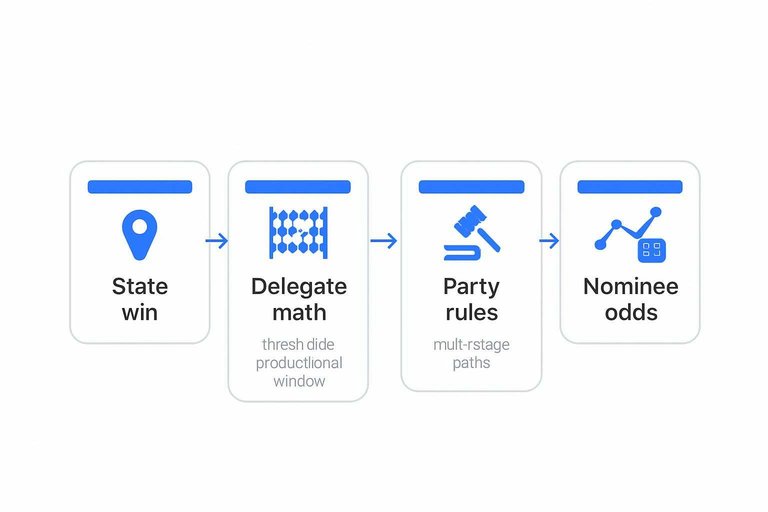
Primary results translate into delegates, not a nominee badge. The U.S. Election Assistance Commission frames presidential primaries as voters choosing party delegates “rather than for candidates themselves,” so the same vote margin can matter less (or more) depending on how it converts into delegates.
-
The nomination is governed by party rules, not a single government-run election outcome. The Congressional Research Service emphasizes the presidential nominating process is “a political one, not a governmental one,” and parties set the rulebook that determines how a candidate becomes the official nominee.
-
A state can be “won” while yielding only a partial delegate gain. Under RNC rules, the Proportional allocation window (RNC)—a party-rule period where delegates must be allocated proportionally (not winner-take-all)—applies to Republican contests held prior to March 15, limiting how much one early-state win can move the nomination tally.
-
Thresholds make delegates discontinuous. RNC rules allow states to set a minimum threshold (capped at 20%) below which a candidate receives no delegates, so a close statewide finish can produce a sharp delegate swing—or almost none.
-
Paths can be multi-stage. Some “primary” definitions include an additional round (like a runoff) if no one hits the required level, so a clean “won the state” headline may not match what ultimately counts for nomination odds.
That’s why “state winner = nominee probability” is an unreliable hedge unless you explicitly map the state outcome into delegates and rule-driven paths to the nomination.
Basis risk in hedging
Basis risk—the risk that your hedge contract settles on a different outcome than the risk you’re trying to offset—shows up when “what pays” in your hedge isn’t the same thing that drives your real P&L.
In the united states presidential primary, the gap is structural: a nominee position is exposed to the party’s end-state decision, while a state-primary position is exposed to one dated contest with its own reporting/verification path. When those paths diverge, your hedge can move the wrong way: the state bet loses money while your nominee exposure is getting more dangerous (or vice versa).
Use nominee markets
- You need protection against the final nominee. If you’re short (or otherwise hurt by) Candidate A becoming the nominee, the hedge that pays on “Candidate A is the nominee” offsets that risk cleanly.
- Delegate math is the real state variable. The Republican race is a 2,429-delegate problem, not a “who won State X” problem; a state win can be a small slice of what ultimately matters.
- Withdrawals and consolidation are your enemy (and your hedge’s). A candidate can lose a headline state, then benefit from rivals dropping out and still get to a winning delegate path—your state hedge may pay while your nominee exposure gets worse.
- You’re trying to avoid wrong-way P&L. The simplest test: if Candidate A loses your chosen state hedge but still looks more likely to be nominated the next morning, that hedge has done the opposite of its job.
Use state markets
- Your exposure is to a specific event window. If you’re managing election-night swings, headline risk, or a Super Tuesday narrative shock, a state contract is closer to the thing you’re actually trading.
- You want a hedge that reacts to a single datapoint. A state result can gap prices immediately even if it barely changes the delegate endgame; that’s useful when your P&L is marked-to-market on news.
- You can tolerate “local” settlement risk. Some contracts depend on a named caller or source to finalize who won; the Associated Press, for example, reported it was unable to declare a winner in Iowa’s Democratic caucuses in 2020.
- You’re hedging timing as much as outcome. State hedges are about the moment the state outcome becomes known to the market, not about who the party nominates months later.
Audit settlement rules
Before you size a hedge in the united states presidential primary, read the settlement block like a risk disclosure: it tells you what counts as the outcome and who gets to prove it. Use MarketsPrediction to compare liquidity/volume for the exact contract you chose.
Trigger and sources
- Start with the trigger: projection vs certification. Some contracts settle off election-night calls (fast), others wait for certified results—final, official results published by the relevant authority after verification, which can arrive well after headlines.
- Identify the resolution source / Source Agency. That’s the specific authority or publications the rules name as evidence for the outcome (for example, a Secretary of State site, a party authority, or a defined list of media outlets). If the rule names multiple sources, treat it as a hierarchy and find the tie-breaker.
- Check whether the market resolves by “written rules,” not vibes. Polymarket says markets are resolved according to the market’s pre-defined written rules, and once resolved, winning share-holders receive $1 per share while losing shares become worthless.
- Find the dispute/challenge process and timing. Polymarket also describes a 2-hour challenge period once a resolution is proposed; that matters if you’re relying on a tight settlement window for capital recycling.
- Sanity-check “same title, different contract.” Even when two venues look arbitrageable, differences in contract definitions and resolution sources can make positions non-equivalent—especially when one settles on certification and another settles on a media-source consensus.
Edge-case clauses
- Runoff handling. A runoff is an additional election round required when no candidate meets a stated threshold; if the rules include it, your time-to-resolution can extend to the runoff date (and beyond).
- Write-ins and “Other.” Look for language that defines whether write-ins are eligible to win, whether they’re grouped into an “Other” bucket, and what happens if “Other” finishes first.
- Recounts, litigation, and reversals. Don’t assume “called” equals “final”; look for explicit language about whether later corrections or legal outcomes can change resolution.
- Cancellation/postponement. Find the clause that says what happens if a contest is cancelled, not held, or delayed past the contract’s expiration (refund, void, or alternative source).

Resolution-source risk: when “who decides” breaks your hedge
Even if the market’s outcome definition matches your exposure, hedges still fail when the resolution source can’t (or won’t) produce a clean, timely answer.
- Named source can’t call it. If the rules lean on a specific caller or outlet list, you’re exposed to their ability to declare a winner. The Associated Press has documented a caucus case where it was unable to declare a winner (Iowa’s Democratic caucuses in 2020), which is the exact failure mode that turns “event risk” into “capital stuck until the rule’s fallback triggers.”
- Certification vs projection: don’t mix triggers across legs. A state primary hedge that resolves only on official certification can stay open while a nominee (or headline-driven) leg settles on a media call. That gap is pure basis risk: you can be directionally right and still be forced to carry the wrong instrument longer than planned.
- Multi-source hierarchies: find the tie-breaker, not the list. Some contracts name several outlets/agencies; what matters is the clause that says what happens when sources disagree, update, or never publish the needed detail. If you can’t point to the rule that breaks ties, you don’t actually know what you bought.
- Edge clauses that flip “obvious wins” into losses. Two recurring gotchas appear verbatim in real primary-market rules:
- Write-ins / “Other” buckets: one Kalshi primary-results contract states that if a write-in candidate achieves the specified rank, all named-candidate markets resolve to “No” unless a specific “Write-in” or “Other” option exists.
- Cancellation/postponement past expiry: that same contract states that if the election is cancelled or postponed beyond expiration, “all markets resolve to No.” If your hedge assumes “void/refund,” you’re taking a different bet than you think.
Practical check: before you size the hedge, read the resolution section as if you’re trying to prove the opposite side’s case—exact trigger, exact source, exact fallback, and the exact clause for weird outcomes (write-ins, runoffs, cancellation).
Decision matrix
Use nominee contracts for the thing that actually ends your risk (the party’s official nominee). Use state-primary contracts for short, dated shocks you care about in the united states presidential primary.
| If your P&L is hurt by… | Baseline hedge | Tactical overlay | Monitor as “rules-of-the-game” inputs |
|---|---|---|---|
| Candidate A becomes the nominee | Nominee market | None needed | Party rule changes; withdrawal timing |
| News-driven gaps on a specific contest night | Nominee market | State winner or margin | Projection vs certification trigger; runoff clauses |
| Delegate math, not headlines | Nominee market | State only if delegate-relevant | Allocation window; thresholds; delegate counts |
| Democratic nomination path details | Nominee market | State overlays near key contests | CRS delegate split: 4,521 total; 3,770 pledged; 749 automatic |
| You want both: outcome + event hedging | Core nominee position | Add state overlays around early states and Super Tuesday | Source hierarchy; dispute windows; cancellation rules |
Size the nominee position as your “always-on” hedge, then treat state positions as expiring insurance you roll only into the next dated catalyst.
Hedge the outcome, not headlines
If your risk is “Candidate A becomes the nominee,” hedge with a nominee contract—because that’s the only settlement that ends the risk you actually have. Treat state winner/margin markets as short-dated overlays for specific contest-night swings, not as a substitute hedge, since they can pay (or fail to pay) while your nominee exposure moves the other way. Before you size anything, read the settlement block like a term sheet—trigger, resolution sources, disputes, and edge cases are where the hedge can break. Once you’ve picked the exact contract type you need, use a cross-platform screener to find the venue where that specific market is most tradable; if you’re only trying to catch a single night’s move, skip the nominee leg and just trade the state event you actually care about.
Frequently Asked Questions
- What does a $0.60 price mean in a united states presidential primary nominee market, and what’s the payout if it resolves YES?
- In a $1-settled event contract, the price is the market’s implied probability-like price for YES in dollars. On Kalshi, these markets use a $1.00 settlement value and trade in $0.01 ticks, so a YES share resolves to $1 and a NO share resolves to $0.
- Are united states presidential primary prediction markets regulated in the U.S., and why does the CFTC matter?
- Yes—U.S. derivatives regulators can take action when a platform offers markets in a way that violates U.S. rules. The Commodity Futures Trading Commission ordered Polymarket in 2022 to pay a $1.4 million civil monetary penalty and to cease and desist and wind down noncompliant markets.
- Do I need to trade state primary winner markets to hedge united states presidential primary risk, or can I hedge with binary event contracts only?
- You can hedge with binary event contracts as long as the contract’s settlement condition matches the risk you’re offsetting (for nomination risk, that means a nominee-definition contract). Use state primary contracts only when your exposure is specifically to that dated state outcome or its market-moving headline window.
- How long do I have to dispute a resolution on Polymarket for a united states presidential primary market?
- Polymarket’s Help Center describes a 2-hour challenge period after a resolution is proposed. If your hedge relies on fast capital recycling, that dispute window is part of your timeline risk.
- How can I quickly compare liquidity and odds for the same united states presidential primary market across Kalshi, Polymarket, and other platforms?
- Use MarketsPrediction to scan the same event across platforms and compare live implied odds alongside volume and liquidity. Start by filtering to the specific contract family (nominee vs state contest) so you’re comparing like-for-like settlement rules.