
 Best Platforms
 Live Odds







What Is a US Senate Prediction Market for Beginners?
An explainer on US Senate prediction markets for beginners—learn what contracts represent, why prices move, how to read odds from prices, how market types differ, and what these markets tend to get right (and wrong).
If you’ve ever seen a headline like “Candidate X is at 62%” and wondered who decided that number, you’re not alone. Senate prediction markets can look like polling, betting, and investing all at once—and the terminology makes them feel harder than they are.
This explainer breaks the basics into plain English: what a Senate contract actually means, why the price changes, how to interpret prices step by step, and how different market formats compare. You’ll also see who trades these markets and what they’re surprisingly good at predicting.
Prediction Market Basics
A prediction market is a marketplace where you trade contracts linked to real-world outcomes. You are trading probabilities, not opinions. A “US Senate market” is a set of those contracts focused on who wins Senate races and who controls the chamber.
Plain-English definition
Prediction markets let you buy and sell contracts tied to an outcome. The contract price moves as traders react to information. In practice, the price acts like a crowd-made estimate of the chance something happens.
Senate market focus
A US Senate market targets election outcomes involving the Senate. Some contracts cover chamber control, like which party gets a majority. Others focus on single states, like who wins a specific race.
Why prices move
Prices move when beliefs change, or when trading gets easier or harder.
- Breaking news changes expectations
- New polls shift perceived odds
- Liquidity affects price stability
- Traders disagree, then trade
- Fresh info arrives over time
Watch the catalyst, not the chart. The story is usually in the new information.
What a contract means
Many contracts are easiest to understand as: “Pays $1 if X happens.” If it trades at $0.60, the market is roughly treating X as a 60% chance. It’s a translation layer from event outcomes to a simple price.
Two common pitfalls
Markets feel precise, which makes these mistakes tempting.
- Treating probability like certainty
- Treating price like objective truth
Use the price as a signal, then sanity-check the assumptions behind it.
How to Read Prices
Contract prices look like quotes, but they’re really a shorthand for “how likely is this outcome.” You read the number, map it to probability, then sanity-check it against how the market pays out.
- Identify the contract’s payoff rule in one sentence (for example: “Pays $1 if Candidate A wins, else $0.”)
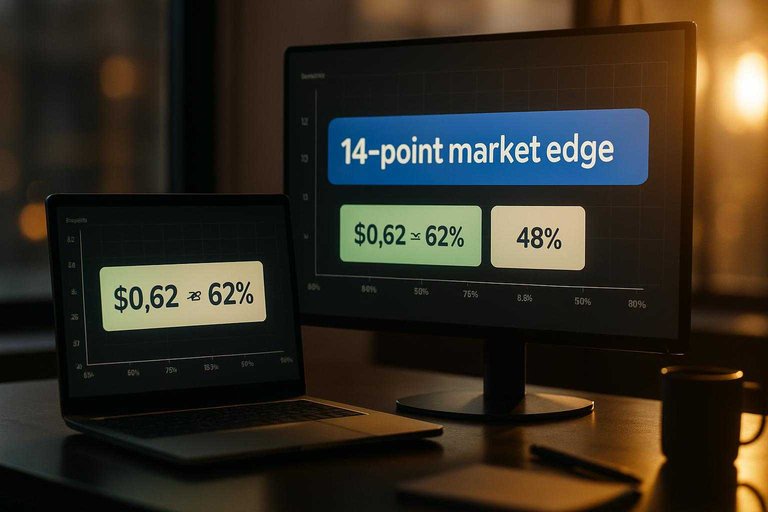
- Convert the current price into implied chance by treating it like cents-on-the-dollar (for example: $0.62 ≈ 62%).
- Translate that chance into odds by comparing win vs. lose (for example: 62% implies 62-to-38, roughly 1.6-to-1).
- Read “spreads” as differences between outcomes or candidates (for example: 62% vs 48% suggests a 14-point market edge).
- Add the missing context: fees, bid–ask spread, and contract wording can change what the price really means.
If you’re tracking a primary market specifically, follow steps to track a Senate primary so you don’t mix up the race or contract. If you want to judge how good a probability estimate is over time, use accuracy metrics for Senate forecasts to score it.
Prices are the market’s claim, not a guarantee, so your next move is checking whether the rules and frictions distort it. For a concrete example of $1 settlement and the cents-on-the-dollar scale, see event contract mechanics.
Market Types Compared
Different Senate prediction markets answer different questions, even when they look similar.
Pick the structure that matches what you’re trying to learn, not what seems most popular.
| Market type | What you’re trading | Best for beginners | Common pitfall |
|---|---|---|---|
| Winner-take-all | One party wins | Simple basics | Ignores margin |
| Party control | Majority control | Big-picture view | Hides key races |
| Seat count range | Seats within band | Understanding distributions | Bands feel arbitrary |
| Race-by-race | Each state outcome | Learning local dynamics | Too much to track |
| Conditional markets | Outcome given event | Causality thinking | Easy to misread |
Choose one market type first, then add complexity only when your questions get sharper.
Who Trades and Why
US Senate prediction markets attract different kinds of traders, and each group moves prices for different reasons. Those motives shape how quickly prices update, how noisy they get, and when you should trust them less.
Information seekers
You use the market because you want a single number that updates fast. Price becomes a living headline, especially when news is scattered across filings, local reporting, and small signals.
Imagine a late-breaking story hits during a busy workday. You don’t read ten threads and three newsletters. You check the contract, see it move, then decide what to dig into next.
Treat the price as a pointer, not a proof.
Speculators
Speculators trade to make money from being right about mispricing. They’re the ones who try to buy “too cheap” candidates and sell “too expensive” ones.
They watch for new information, but they also watch other traders’ overreactions. When they act, they can pull prices back toward what the broader evidence suggests.
If the speculators leave, the market gets loud and slow.
Partisans and hobbyists
Some traders show up to express identity, back a team, or enjoy the game. Their motive is narrative first, price second.
- Buy to signal loyalty
- Hold through bad news
- Trade on vibes
- Chase viral takes
- Average down emotionally
That’s when you can see temporary distortion, especially after culture-war moments.
Market makers and liquidity
Liquidity is how easily you can trade without moving the price much. When liquidity is low, small orders can cause big swings, and the chart starts to look dramatic for no real reason.
A thin market often has wide bid-ask spreads and jumpy moves between trades. You’ll see prices “gap” because there weren’t enough standing orders to absorb normal buying or selling.
Before you trust a move, check if anyone actually had to pay for it.
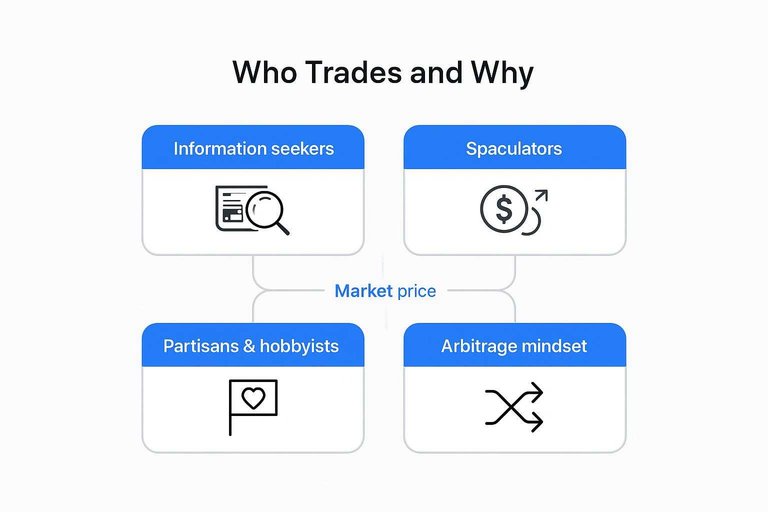
Arbitrage mindset
Some traders constantly compare sources and trade the differences. They’re trying to exploit gaps between markets, polls, models, and fundamentals.
- Compare market price to poll averages
- Compare to forecast models
- Compare across platforms
- Trade when gaps widen
- Exit when prices converge
Disagreement can linger when costs, limits, or rules block clean arbitrage. For research on how constraints can shape these gaps, see arbitrage in political prediction markets.
What Markets Get Right
Prediction markets can help you track a US Senate race when you want a fast, aggregated signal, not a guaranteed answer.
- Aggregate many small bets into one signal
- Update continuously as new information arrives
- React quickly to breaking news and shifts
- Turn confidence into a visible price
- Expose disagreement between narratives
Treat the market price like a living forecast, then sanity-check it with the news and fundamentals.
Beginner Risk Management for US Senate Prediction Trading
If you’re new to us senate prediction markets, the biggest mistake isn’t “being wrong” — it’s letting one trade (or a string of small, poorly priced trades) do disproportionate damage to your bankroll. The goal is to stay in the game long enough to learn how prices move, how news gets absorbed, and where your edge actually comes from.
Below are practical guardrails that help beginners avoid common blow-ups:
Set a bankroll and keep it separate
Treat prediction trading as a closed bankroll (money you can afford to lose and won’t need for bills or emergencies). Keep it separate from everyday finances so you’re not tempted to “top up” impulsively after a loss.
A simple approach:
- Decide a fixed bankroll amount.
- Decide a fixed time horizon for that bankroll (e.g., this election cycle).
- Accept that the bankroll can go to zero — plan your sizing so it’s unlikely to happen quickly.
Use position sizing rules (avoid all-in thinking)
Beginners often bet based on conviction rather than risk. A better habit is to size positions as a small fraction of your bankroll so you can be wrong without getting wiped out.
Practical sizing ideas:
- Start small by default. Early on, consider making your “standard trade” a small, repeatable unit rather than a one-off big bet.
- Scale up only with a reason. Increase size only when (a) you can explain your edge clearly, (b) you’ve checked liquidity, and © the price you’re getting is actually available in size.
- Diversify carefully. Holding multiple Senate races can reduce reliance on a single outcome, but don’t assume diversification if the positions are driven by the same national narrative (they may move together).
Account for fees, spreads, and the cost of being early
Your “true” break-even isn’t just whether you’re right — it’s whether you’re right enough to overcome trading frictions.
Key costs to watch:
- Fees: Some venues charge per trade, per contract, or on profits. Know what applies before you click.
- Bid–ask spread: If you buy at the ask and immediately sell at the bid, you’ll usually lock in a loss. Wide spreads are a warning sign for beginners.
- Opportunity cost: Tying up bankroll in slow-moving positions can prevent you from taking better-priced opportunities later.
Beginner habit: before entering, ask “If I needed to exit quickly, what would it cost me?”
Respect liquidity and slippage (especially in smaller races)
Liquidity is how easily you can enter/exit near the displayed price. In thin markets, the price you see may only be available for a tiny amount.
What to do:
- Check the order book depth (or whatever liquidity indicator the platform provides). Don’t assume you can get your full size at the headline price.
- Use limit orders when possible. Market orders can fill at much worse levels during news spikes.
- Avoid chasing sudden moves. If a price jumps on breaking news, spreads often widen and fills get worse. Waiting for conditions to normalize can be a form of risk management.
Have an exit plan before you enter
A beginner-friendly trade isn’t just “buy Yes” — it’s a full plan:
- Entry: What price makes it worth it?
- Invalidation: What would make you admit you’re wrong (new information, changed assumptions, price moving beyond a point)?
- Exit: Are you holding to settlement, or will you take profits/losses earlier?
Common novice trap: refusing to exit because “the election is months away.” Prices can move against you long before settlement, and your bankroll can be tied up or stressed the entire time.
Know when not to trade
Skipping trades is a skill. These are common “no-trade” situations for beginners:
- You can’t explain your edge in one sentence. “I have a feeling” is not a thesis.
- The market is too thin. If spreads are wide and fills are uncertain, the friction may overwhelm any small informational advantage.
- You’re trading emotionally. Revenge trading after a loss, or FOMO after a headline, usually produces the worst entries.
- You don’t understand the contract rules. If you’re unclear on settlement conditions, edge cases (runoffs, replacements, special elections), or how the platform defines the outcome, don’t trade.
- Your position would keep you up at night. That’s a sign it’s oversized relative to your bankroll and risk tolerance.
As a beginner, your first objective is consistency: modest sizing, clear reasons, and trades you can manage calmly.
Use Senate Markets Like a Pro (Without Overtrusting Them)
Treat a US Senate prediction market as a real-time, tradable consensus—not a crystal ball. Read the price as an implied probability, then ask what new information could move it and whether liquidity is strong enough to trust the signal. Keep an eye out for the two classic traps: confusing “price” with “certainty,” and overreacting to short-term swings in thin markets. Used this way, markets become a helpful input alongside polling, fundamentals, and news—not a replacement for them.
Frequently Asked Questions
- Are US Senate prediction markets legal to use in the United States in 2026?
- Legality depends on the platform and jurisdiction: some operate under U.S. regulatory oversight, while many real-money election markets are restricted for U.S. users. Check the site’s terms, geo-restrictions, and any regulator disclosures before trading.
- How do I evaluate whether a US Senate prediction price is trustworthy or just noise?
- Look for liquidity and trading volume, a tight bid–ask spread, and whether the price is stable across multiple reputable markets. Also check if the move aligns with a specific public catalyst (poll release, debate, major news) rather than a single abrupt spike.
- Do I need polling data to use a US Senate prediction market effectively?
- No—markets already incorporate polling and news into the price, so beginners can start by using the market as a summary signal. Polls are still useful as a cross-check when a price move seems disconnected from recent polling trends.
- What’s the difference between a US Senate prediction market and election betting odds from sportsbooks?
- Prediction markets typically reflect tradable contract prices set by market participants, while sportsbook odds are set by bookmakers and adjusted for risk and margin. Both can imply probabilities, but they react differently to liquidity, limits, and operator policies.
- How often do US Senate prediction markets update, and how should beginners monitor them?
- Prices can update continuously whenever trades occur, and activity often accelerates around major news or late in the cycle. For beginners, set a simple routine: track price changes alongside a news timeline and compare against at least one other market for confirmation.