
 Best Platforms
 Live Odds







What Is the “Marco Rubio for President” Market and How Does It Work?
A pillar guide to understanding the “Marco Rubio for President” prediction market contract—how the Yes/No instrument is defined and settled, how order books and spreads shape trading, and why prices move with information, liquidity, and market microstructure dynamics.
You pull up a “Marco Rubio for President” market and see a price that looks like a probability—but is it actually one, and what makes it change minute to minute?
This guide breaks down what the contract really promises, who operates the venue, and how trades get matched. You’ll learn how to read quotes and spreads, why headlines can create gaps, where misconceptions come from, and what happens at settlement when the market has to decide—using evidence—whether the outcome is Yes or No.
Market at a Glance
A “Marco Rubio for President” market is a tradable contract on whether Rubio wins the specified election under a written rulebook. You’re not buying a headline or a vibe. You’re buying a yes/no payout defined by settlement terms.
Most versions trade like binary contracts: they settle at $1 if the condition happens, and $0 if it doesn’t. Your job is reading the condition, then deciding whether the current price misstates the true chance.
Contract meaning
The contract’s meaning is the settlement condition, not the narrative around it. “Rubio wins” usually points to a specific office, election date, and certifying authority.
In practice, rulebooks often define “wins” as being inaugurated, being certified by a named body, or being the official winner after a final call. Some specify party nomination instead of the general election, so the scope can shift from “wins the presidency” to “wins the GOP nomination.”
Settlement criteria matter because markets pay on the rule, not the headlines.
Who runs it
You’re trading inside someone else’s rule set, with their own enforcement and dispute process. Venue choice changes what “fair” even means.
- Prediction markets with published settlement rules
- Sportsbooks with house-set lines and limits
- Exchanges matching buyers and sellers
- Brokers offering event-style contracts
- Hybrids using third-party arbitration
If governance is murky, your edge can vanish into a ruling.
Price as probability
In many binary markets, a quoted price near $0.62 roughly maps to a 62% implied probability. That mapping comes from the $1 payout at settlement: paying $0.62 to receive $1 is “priced like” 62%.
The mapping breaks when you add meaningful fees, withdrawal costs, position limits, or when one side can’t participate. It also breaks when the contract has unusual settlement timing, ambiguous terms, or hard-to-hedge exposure.
Implied odds tell you what traders must accept to transact, not what you should believe.
Bid-ask spread
The “last price” is often a single fill from minutes ago, maybe for a tiny size. What you can buy now is the ask, and what you can sell now is the bid.
Spreads widen in thin markets, and depth thins out fast once you move past the top quote. If you place a market order, slippage can push your average fill well away from the headline price.
Trade the executable price, or you’re trading a screenshot.
Position outcomes
Your payoff is capped, but your path to that payoff can be messy. Know the ceiling and the floor before you click.
- Long “Yes”: max gain is $1 minus entry price
- Long “Yes”: max loss is entry price
- Short “Yes” (or long “No”): max gain is entry price
- Short “Yes” (or long “No”): max loss is $1 minus entry price
- Holding through settlement: payout follows the rulebook outcome
If you can’t state max loss in one breath, you’re not ready to size it.
Contract Anatomy
Every “Marco Rubio for President” market is just a contract with a tight definition and a clock. Read the anatomy first, because most surprises come from the fine print, not the news.
Underlying event
The contract anchors to a specific real-world event, like official election results or formal certification. That source matters because it turns messy politics into a checkable yes-or-no fact.
Common sources include state-certified results, the Electoral College vote, or a designated government publication. The cleaner the source, the fewer “but what if…” disputes you face when it’s time to settle.
Pick the contract with the most objective source. Ambiguity is where bad fills and angry appeals live.
Settlement rules
Settlement rules decide how the market handles weird but realistic scenarios. You want to know them before you place size.
- Candidate withdraws or suspends campaign
- Candidate switches parties or runs independent
- Candidate dies or becomes incapacitated
- Certification is delayed or incomplete
- Results are contested or litigated
If the rulebook feels vague, treat the contract like it’s already in overtime.
Expiration timing
Expiration is the moment the platform stops trading and starts resolving. It might be tied to Election Day, certification, inauguration, or “when the outcome is known.”
Some contracts resolve early if the event becomes impossible or effectively decided, like a candidate exiting the race. Others linger after Election Day if the contract keys off certification, recounts, or court outcomes.
Timing is your hidden risk factor. Longer windows invite more headlines, more gaps, and sharper volatility.
Yes/No structure
This market is a binary contract: “Yes” pays if Rubio becomes President, “No” pays if he doesn’t. Your profit comes from buying below the eventual settlement or selling above it.
It behaves like a digital option because the payoff jumps from zero to full value at settlement. As price drifts toward 0 or 1, sensitivity changes fast, and small probability updates can move price a lot.
Near the extremes, you’re not trading politics anymore. You’re trading tiny changes in implied odds.
Early delisting
Platforms sometimes halt trading and close the market before the planned expiration. That can be routine, or it can be chaotic.
- Legal or regulatory pressure
- Persistent low liquidity or inactivity
- Manipulation concerns or rule violations
- Contract definition errors or rule changes
- Platform outage or market shutdown
When a market closes, you usually get a forced settlement or a refund under the platform’s rules. Know which one applies before you assume you can “just exit later.”
Order Matching Internals
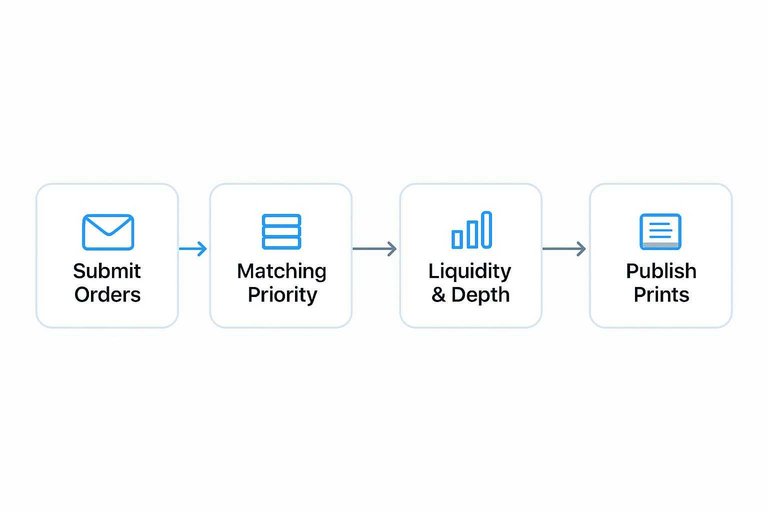
Exchanges don’t “decide” the Marco Rubio price. They run a queue, match compatible orders, and publish prints.
In thin political markets, small orders can move the display fast. That’s why you see jumpy moves instead of smooth curves.
Order types
A political contract trades like any other: you submit instructions, and the book either fills them or queues them. Thin books make each instruction louder, because there’s less resting liquidity to absorb it.
Market orders cross the spread and fill against the best available prices until complete. Limit orders rest at a chosen price and only trade when someone hits them. Cancel/replace removes your old queue spot and re-enters you at the back, often at the worst moment.
If the book is thin, “careless” market orders pay up fast, and impatient replaces donate priority.
Matching priority
Most venues match orders with a simple rule set, and tiny details change who gets filled. In political markets, priority is often the whole edge.
- Price-time priority: best price first, then earliest timestamp.
- Maker orders add liquidity and earn queue position.
- Taker orders remove liquidity and pay the spread.
- First at a price captures incoming flow.
- Being right later can still miss fills.
If you aren’t first in line, your “great price” can be decorative.
Liquidity and depth
Depth is the stack of limit orders at each price, usually shown as a ladder or chart. It tells you how far price must travel to fill size.
A large order can “walk the book,” filling multiple price levels until it’s done. Each level consumed reveals the next, so the last traded price jumps. Around breaking news, resting orders get canceled, spreads widen, and the book turns to fog.
When liquidity evaporates, the displayed price becomes a snapshot of panic, not a stable consensus.
Arbitrage links
Related contracts create guardrails, because traders compare prices across the web of outcomes. If one leg drifts, someone can buy the cheap side and sell the rich side.
Think nominee markets, party-win markets, and state-outcome markets as constraints on each other. A candidate’s nomination odds shouldn’t exceed the party’s overall win odds by much without a story. If state paths imply a higher chance than the headline market, the spread invites pressure until it narrows.
No-arbitrage doesn’t make prices correct. It makes inconsistencies expensive.
Manipulation mechanics
Thin markets are easier to nudge because the book is small and attention follows the tape. Some tactics move “last price” more than they move real clearing odds.
- Spoofing-like stacking: show size, pull before execution.
- Wash-like prints: trade with yourself to paint activity.
- Low-float pushes: sweep small depth to print higher.
- Quote stuffing: rapid updates to crowd the book.
- Marking the close: push the final print.
Watch the book, not just the chart. The tape can be theater. For context on what venues must prohibit, see abusive trading practices prohibited.
Why Prices Move
Prices in a “Marco Rubio for President” market move when new facts collide with existing positions. The chain is simple: information hits, beliefs update, risk limits bind, and the crowd reacts together.
Information arrival
Price changes start with surprises, not headlines you expected. The highest-impact inputs are the ones that change vote math, access, or perceived viability.
Polling moves matter when they shift a narrative across multiple pollsters, not one outlier. Endorsements matter when they unlock networks or signal coalition strength. Fundraising matters when it changes how long a campaign can stay loud. Debate moments matter when they are clean, repeatable clips. Ballot access matters because it turns “possible” into “available.”
If the new info changes the path to delegates or the general election map, expect fast repricing.
Belief aggregation
Traders can see the same headline and price it differently. Disagreement is the fuel that creates trades.
- Different priors about electability and coalitions
- Different models for polls and momentum
- Different time horizons for holding risk
- Different attention to local versus national signals
- Different weighting of debates versus fundamentals
When those differences line up, the market stops arguing and starts trending.
Risk and inventory
A market maker is not “predicting”; they are managing exposure. When buys swamp sells, they raise the ask, lower the bid, and widen spreads to slow the flow.
They also shade quotes to attract the side they need. If they are long too much “Yes,” they make “Yes” less attractive and “No” more attractive. Risk limits, capital constraints, and uncertainty around fresh news all push them toward wider pricing.
When one-sided flow hits, the price is often a risk-control tool first.
Reflexivity loops
Markets don’t just reflect beliefs; they can amplify them. A rising price draws in trend-followers, triggers “fear of missing” entries, and creates more aggressive market orders.
Media and social narratives can pick up the move and treat it as signal. That attention pulls in new traders, which adds more one-way flow, which moves the price again.
If you see price action leading the conversation, you’re watching reflexivity at work.
Event-driven gaps
Sometimes the price doesn’t move smoothly; it jumps. Gaps happen when trading can’t keep up with the new reality.
- Trading halts around major uncertainty
- News drops outside peak liquidity windows
- Thin order books near key events
- Platform downtime or degraded execution
- Temporary restrictions on orders or sizes
If liquidity disappears for a moment, the next print can look like a cliff.
Trading vs Betting
Headlines make prediction markets and sportsbooks look interchangeable. Mechanically and legally, they are different machines. That’s why the same “Marco Rubio for President” odds can split apart and stay apart.
Counterparty structure
Prediction exchanges match you against other users, so your counterparty is another trader. Sportsbooks take the other side, so your counterparty is the house.
On an exchange, prices move when new orders appear, get canceled, or get filled. The venue manages matching, margin, and settlement, not a risk book. Liquidity providers and informed traders set the market’s “feel,” including gaps and sudden jumps.
At a sportsbook, the book posts lines, limits exposure, and moves odds to balance action or protect risk. The goal is controlled liability, not perfect price discovery. Promotions, marketing goals, and correlated outcomes can shape the line too.
If you see a tight spread and deep size, you’re looking at a trading venue, not a house opinion. (See Kalshi’s overview of peer-to-peer event contracts.)
Limits and restrictions
Rules decide who can show up and how big they can play. Those frictions keep “free money” trades from lasting.
- Maximum stake caps per market or account
- Identity checks and source-of-funds reviews
- Jurisdiction blocks based on location
- Account limits, closures, or stake reductions
- Withdrawal and deposit constraints
When one side can’t bet or can’t size up, divergence becomes the normal state.
Fees and vig
Exchange pricing usually includes a spread plus a commission on winnings or trades. Sportsbooks bake in vigorish by shading both sides so implied probabilities sum above 100%.
On an exchange, your breakeven moves with fees and fill quality. A great headline price can be bad if you cross a wide spread or pay a high commission on frequent trades.
At a sportsbook, the vig is the quiet tax. Two books can show similar “Rubio” odds, yet differ in hold, limits, and how quickly they move.
Before you compare odds, convert them to after-fee, after-vig breakevens.
Rule enforcement
Markets need a referee, because reality doesn’t always resolve cleanly. Exchanges and books differ in who decides, what evidence counts, and how appeals work.
Prediction markets lean on written resolution criteria: official announcements, certification dates, named sources, and edge-case clauses. If a candidate suspends, resumes, replaces a running mate, or faces a contested convention, the exact wording governs settlement.
Sportsbooks also use house rules, but they often reserve broader discretion. They may void, grade as no-action, or settle based on their chosen authorities when events get chaotic.
Messy outcomes don’t just create drama; they create settlement risk you must price in. Polymarket summarizes this in its resolution process documentation.
Reading a Quote
A market page quote looks simple, but each field encodes rules, incentives, and failure modes. Read the page like a contract, not a headline.
A quick scan of these fields tells you what you’re really buying.
| Field on market page | What it tells you | Why it matters | Common risk signal |
|---|---|---|---|
| Contract question | Exact resolution claim | Defines winning condition | Ambiguous wording |
| Outcome set | Allowed settlement options | Limits your exits | Missing edge cases |
| Price (Yes/No) | Implied probability | Sets entry value | Wide Yes/No gap |
| Volume / liquidity | How tradable it is | Affects slippage | Thin order book |
| Resolution source | Who decides truth | Drives settlement risk | Unclear authority |
Treat “resolution source” as the boss fight; if it’s messy, everything is.

Comparing prices, spreads, and liquidity across platforms
A “Marco Rubio for President” contract can trade at meaningfully different prices on different venues at the same moment. Don’t treat that as one platform being “right” and another “wrong” by default—treat it as a clue about microstructure.
Use this quick cross-platform checklist before you click buy/sell:
- Match the contract first (then compare price). Confirm you’re looking at the same resolution claim and the same outcome set (e.g., “wins the Republican nomination” vs “wins the presidency,” or a market that includes “other” vs one that doesn’t). If the wording or settlement criteria differ, the prices are not directly comparable.
- Compare the mid, not just the last trade. A “Price (Yes/No)” may reflect the last fill or a displayed best price. For apples-to-apples, look at the best bid and best ask (or Yes/No equivalents) and estimate the mid between them. A single small trade can print an outlier “last” without changing the true tradable level.
- Read the spread as a transaction cost. A tighter bid–ask spread usually means you can enter/exit closer to the displayed probability; a wider spread means you’re paying more to cross the market. If two platforms show similar mids but very different spreads, the tighter one is typically easier to trade at the quoted level.
- Check liquidity at the size you care about. “Volume” can be high while the current order book is thin (or vice versa). If you can, look for depth or a way to estimate slippage: how far the price would move if you tried to buy/sell your intended stake.
How to interpret common mismatches:
- Same question, different prices + thin liquidity: often just noise—one venue updated recently or had a small trade that moved the quote.
- Same question, different prices + tight spreads on both: the market is genuinely disagreeing; treat it as a signal to re-check the resolution rules and your own assumptions.
- One platform tight, another wide: the wide one may be harder to exit quickly without giving up edge, even if the headline price looks “better.”
- High volume but wide spread: activity may be concentrated in bursts or at specific price levels; don’t assume you can trade efficiently right now.
The goal of scanning across platforms isn’t to find a “true” probability—it’s to find where the contract is actually tradable at the price you think you’re getting.
Common Misconceptions
These markets look like simple “who wins?” polls, so people import polling logic. The market’s own mechanics can make that intuition wrong.
- Price equals probability, always
- Volume doesn’t matter for accuracy
- Headlines move price for “everyone”
- Any contract maps to election day
- Tight spreads mean deep liquidity
Thin liquidity makes prices jumpy, and that’s the root of most confusion.
How Settlement Happens
Settlement is the unglamorous part of a “Marco Rubio for President” market. It decides what counts as “happened,” then turns that decision into cash or final contract states.
Evidence sources
Platforms settle on sources they can audit, link, and defend under pressure. Redundancy matters because a single headline can be wrong, late, or reversed.
Most platforms accept some mix of:
- Major wire calls (like AP), for fast preliminary clarity
- State certification, for the legal outcome
- Court rulings, for disputes that change or block certification
- Official government postings, like election canvass reports
The tighter the evidence stack, the less room there is to argue over phrasing.
Settlement workflow
Settlement is a pipeline with deliberate friction. That friction prevents bad prints and rage-induced reversals.
- The event occurs, and the market may enter a freeze window.
- The platform collects sources and publishes a provisional decision.
- Users get a review period to flag missing or conflicting evidence.
- An appeals window handles formal disputes and edge-case interpretations.
- The platform posts a final settlement and closes the market.
If you can’t point to the freeze step, you’re looking at a platform begging for chaos.
Dispute scenarios
Election outcomes can be socially “known” before they are legally final. Recounts, certification delays, and injunctions can all create a gap between headlines and settlement-grade reality.
In a contested election, platforms may keep trading open with clear rules, or pause it to prevent manipulation. The choice depends on whether new information is still arriving, or the process is just grinding.
Uncertainty is not a bug in these markets. It’s the risk you’re trading.
Payout mechanics
After settlement, the platform needs to turn “Yes/No” into account-level updates. You should expect boring accounting, not drama.
- Winning shares credit at the contract’s payout value.
- Losing shares debit to zero, then close out.
- Short positions pay the difference, then unlock collateral.
- Locked margin releases after final settlement.
- Balances show realized P&L, not just mark-to-market.
If your balance changes before final settlement, it’s usually provisional. Treat it like a receipt pending approval.
Use the Contract Rules Before You Trust the Price
- Read the contract definition and settlement rules first (what counts as “for President,” which evidence sources are valid, and when it expires).
- Interpret the quote as a market price, not a guarantee—check bid/ask, depth, and recent trades to see how fragile the “probability” is.
- Separate information from mechanics: headlines move beliefs, but thin liquidity, inventory risk, and reflexive trading can move price too.
- Before you trade, understand your outcome paths (Yes/No settlement, delisting edge cases, disputes) and the fees, limits, and enforcement that make this different from a simple bet.
Frequently Asked Questions
- Where can I trade the “marco rubio for president” prediction market, and is it legal in the US?
- You can only trade it on platforms that are licensed or permitted in your jurisdiction. In the US, legality varies by platform and state, so check the exchange’s regulatory status and your local rules before depositing funds.
- Is the “marco rubio for president” market predicting the GOP nominee or the general election winner?
- Not necessarily—markets with similar names can settle on different outcomes (nomination, election win, or even “becomes president by any means”). Always read the market’s resolution criteria and official source list to confirm what “for president” means on that contract.
- How do I measure liquidity and slippage in the marco rubio for president market before placing a trade?
- Check bid–ask spread, depth at multiple price levels, recent volume, and open interest; those show how much size you can trade without moving the price. Use limit orders and compare the expected fill price to the mid-price to estimate slippage.
- Can I hedge a marco rubio for president position with other political markets?
- Yes—traders often hedge with related contracts like “Republican nominee” markets, party control markets, or other candidate winner markets that are negatively correlated. The key is matching resolution terms so your hedge doesn’t break due to different settlement rules.
- How are contract payouts handled for marco rubio for president if Rubio drops out, is replaced, or the election is delayed?
- Payout depends on the market’s resolution language, not the news narrative—dropping out often means the contract settles “No,” but some markets specify exceptions. If unusual events occur (replacement candidates, postponements), most exchanges rely on the written rules and may issue clarifications that control settlement.