
 Best Platforms
 Live Odds





World Championship 2026: Prediction Markets vs Sportsbooks—How to Choose
A go/no-go framework for World Championship 2026 exposure: identify the event, confirm access, compare spread+fees, and check grading vs resolution.
You want exposure to a major 2026 world championship result, but picking the “best odds” option upfront is how people end up stuck with the wrong market, the wrong rules, or no access at all.
If you choose before you’ve nailed the exact championship and the market type (winner outright vs match-by-match), you can waste time chasing prices you can’t legally place, pay more than you think once spreads and slippage show up, or get surprised by how the outcome is graded/resolved. This guide gives you a go/no-go framework to choose between sportsbooks and event-contract prediction markets—and what to verify first.
Name the Championship
“World championship 2026” isn’t one event. Search results for that phrase commonly mix the FIFA World Cup 2026, League of Legends “World Championship” (Worlds 2026), and the Pokémon World Championships 2026—three completely different competitions with different calendars, venues, and betting/trading menus. If you don’t pin down which one you mean, you’ll end up comparing a sportsbook line to a market that’s pricing a different sport entirely, which makes any “prediction markets vs sportsbooks” verdict meaningless.
SERP is mixed
If you mean the FIFA World Cup 2026, you’re talking about the men’s tournament hosted across three countries (Canada, Mexico, and the United States) and spread across 16 host cities. That single fact changes what you should even look for: World Cup markets tend to be broad, high-attention, and long-lived, while many other “world championships” are shorter events with fewer broadly listed markets.
If you mean Worlds 2026 (League of Legends) or Pokémon Worlds 2026, you’re in a different ecosystem. The event naming collides in the SERP, but the instruments you can trade—and the depth you can expect—won’t collide at all.
Scope your market
Once you’ve named the event, narrow the market type you actually want to price.
An outright (also called a futures market) is a market on the tournament winner (or another long-horizon outcome) rather than a single match. For FIFA World Cup 2026, that “winner” question sits on top of a tournament structure FIFA describes as 48 teams and 104 matches—so books and exchanges can list everything from the champion outright down to match-by-match prices.
You’ll also see the split reflected on regulated event-contract venues that explicitly label both a “Men’s World Cup winner” series and a “World Cup Game” product in their market listings—effectively the same scoping choice: long-horizon champion exposure versus per-game exposure.
Access Comes First
Before you compare prices for a world championship 2026 market, eliminate anything you can’t actually use from where you’re standing. Access is the first filter because both models can block you before you ever see a line.
Sportsbook constraints
A sportsbook—a bookmaker offering fixed-odds wagers, typically regulated and geofenced by state in the U.S., and graded under house rules—mostly lives and dies by state borders. The American Gaming Association’s baseline is that sports betting is “live and legal in 39 states and D.C.,” which sounds broad until you hit the next constraint.
Geofencing—blocking/allowing access based on your physical location (common for U.S. sportsbooks and some prediction platforms)—isn’t theoretical. DraftKings’ Tennessee Sportsbook terms require you to be at least 21 to open an account, and to be physically located in Tennessee to place wagers. If you travel for matches or even cross a state line, the same account can go from usable to unusable.
Event-contract constraints
An event contract—a contract that pays based on a specified real-world outcome (often $1 for a correct outcome and $0 otherwise), with settlement determined by the contract’s stated rules and source—has a different access shape: federal market structure first, then platform rules.
Polymarket’s terms are blunt about that platform split: polymarket.com blocks trading from the United States and directs U.S. users to polymarket.us, which it says is operated by QCX LLC as a CFTC-regulated Designated Contract Market (DCM). The CFTC’s own DCM listing shows QCX LLC (d/b/a Polymarket US) as “Designated,” dated 2025-07-09.
The catch for 2026 is that “federal vs state” isn’t settled in practice. In an Aug 11, 2026 press release, the CFTC said New York sought a temporary restraining order to prohibit Kalshi from offering all event contracts nationwide (and sought more than $36 billion in damages), and that the CFTC has filed lawsuits against multiple states after state enforcement attempts. If your plan relies on an event-contract venue, verify access close to the day you want to put risk on—because availability can turn on litigation, not just login credentials.
Compare Total Cost
Total cost for a world championship 2026 position isn’t “the fee.” It’s the combined drag from the fee model, the price you can actually trade at, and whether you can get out.
A sportsbook hides most cost in the vig / hold / overround—the built-in margin that makes implied probabilities add up to more than 100%. An order-book venue makes fees explicit via maker / taker pricing (maker posts a resting limit order that adds liquidity; taker hits existing liquidity and usually pays the main fee), but your dominant cost can still be the bid–ask spread (the gap between the best buy and best sell).
| Cost component | Sportsbook (fixed odds) | Prediction market (order book) | What you should compare |
|---|---|---|---|
| Explicit trading fee | Usually none stated | Often charged per fill | Fee paid per entry/exit |
| Embedded margin | Vig/hold in the line | Not in the same way | “Fair” price vs quoted price |
| Spread (quoted price quality) | Hidden inside offered odds | Visible bid–ask | Round-trip cost to enter+exit |
| Slippage (size vs price) | Improves/worsens via limits | Worsens when book is thin | Price change as you size up |
| Exit ability | Cash-out/hedge varies by book | You can sell to exit if buyers exist | Whether you can flatten quickly |
Why “explicit fees” can still lose: if you must cross a wide spread to get filled, that spread is a fee you pay in worse odds. Even the stated fee can be small in isolation—for example, Kalshi’s taker fee is formula-based, and its schedule shows $1.75 for 100 contracts at $0.50—yet execution quality hinges on depth and spread at the moment you trade.
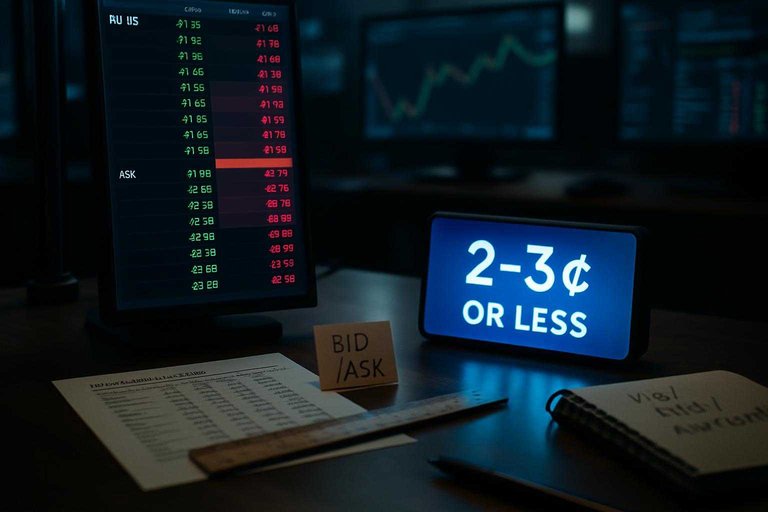
Kalshi has argued this directly: after onboarding Susquehanna International Group (SIG) as a market maker, it claimed (for select markets) 100,000+ contracts of depth and average spreads of 2–3¢ or less. If you don’t see that kind of tight spread and size, the “cheap fee” story stops mattering fast.
Fee Math, Briefly
Fees matter, but only as part of round-trip cost: what you pay to get in and what you pay to exit. In a thin world championship 2026 order book, spread and slippage can dwarf a “low fee” schedule.
-
Kalshi taker fee (formula-based): fees = round up(M × 0.07 × C × P × (1−P)). Here, C is contracts and P is price; the (P × (1−P)) term peaks near 0.50 and shrinks near 0 or 1, so the same position size can face different fees depending on where you trade on the curve.
-
Kalshi fee schedule timestamp: the published schedule is effective July 7, 2026, so use that date when you’re sanity-checking screenshots or older explainers.
-
Kalshi card funding drag: Kalshi states a 2% maximum fee on card deposits. If you’re comparing “effective odds,” that funding fee is part of your true all-in cost.
-
Polymarket US taker fee: 0.06 × contracts × price × (1−price). Same shape: highest fee burden near mid-prices, lower near extremes.
-
Polymarket US taker rebates (volume-based): “rebate tier” means your prior-calendar-month taker volume reduces your taker fees: $250,000–$999,999 gets 10%, and $10,000,000+ gets 50%.
Punchline: once you price a trade as “enter + exit,” you’ll spot when the visible fee is small but the spread is the real tax.
Settlement Reality Check
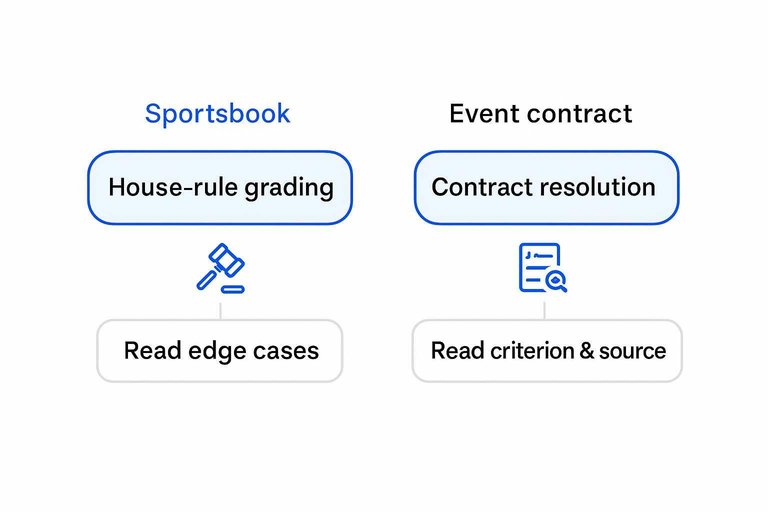
Settlement is where the “same” world championship 2026 view can turn into two different payouts. A sportsbook’s grading—the rule-defined process that decides winners/losers—follows the book’s house rules tied to the sport’s official result. An event contract’s resolution does the same job, but it’s driven by the contract’s written payout criterion and its specified verification source.
Sportsbooks can grade in ways that break “common sense” if you’ve never read the rules. bet365’s soccer rules, for example, say a match abandoned before 90 minutes is “no action,” except for bets that were already determined at the moment of abandonment. That means your position can be voided even if “everyone knows” who was better, and even if the competition later reschedules or completes the match.
Event contracts shift the risk from sport-specific edge cases to document-specific ones: the market resolves when the contract’s cited source says the condition is satisfied, not when the broadcast ends. If the resolution wording is narrower than you assumed—or the named source updates later than the on-field moment—you can be directionally “right” and still not get paid.
The practical takeaway is simple: with a sportsbook, read the house-rule grading edge cases (like abandonment/90-minute conventions) before you bet; with an event contract, read the exact resolution criterion and its verification source before you trade.
Decision Rules (2026)
Pick the instrument that survives three filters: can you access it, can you get filled (and exit) at your size, and can you live with how it settles.
-
Choose sportsbooks when…
-
You want deep in-play (live) menus—moneyline/total/spreads—where the key feature is continuous repricing, not trading out.
-
You value standardized grading under a single operator’s house rules, and you want the “licensed book” model.
-
You’re OK being a price taker: you hit the offered odds and don’t need an order book to be there later.
-
Liquidity needs to be implicit: you don’t want to diagnose spreads, depth, and partial fills.
-
Sportsbook pre-trade checklist
-
Confirm you can place wagers from your location on match day.
-
Read the grading clauses that change payouts (abandonment/voiding, extra time vs 90 minutes, shootouts).
-
Check limits and whether cash-out is offered (and on which markets).
-
Choose prediction markets when…
-
You want tradable outrights (buy now, sell/hedge later) rather than “set-and-forget” futures.
-
You can price-shop across venues and will only trade when the bid–ask spread and displayed depth make your round trip viable.
-
You accept that settlement is contract-resolution driven (wording + source timing), not “whatever the broadcast says.”
-
You’re not leaning on tiny longshots as “cheap lottery tickets”: a 2026 working paper on a major event-contract venue reports a favorite–longshot bias, where low-price contracts win too rarely to break even after fees.
-
Prediction-market pre-trade checklist
-
Verify you’re in the right product type (some U.S. venues list both “Men’s World Cup winner” series and per-game series).
-
Read the exact resolution criterion and source.
-
Screenshot the live book: best bid/ask, depth at your size, and your exit plan.
If You Pick Markets
-
Sanity-check the instrument: you’re here because you want a tradable position (enter now, hedge/exit later). If you need deep in-play menus and standardized house grading, stop and use a sportsbook.
-
In MarketsPrediction, find the exact world championship 2026 market using the platform/category filters (e.g., All Categories and All Platforms) or the lists like Top Markets By Volume / per-platform Top 30.
-
Price-shop the live implied odds (the probability embedded in the current price) across venues, and write down the best “get in” price and the best realistic “get out” price—using the displayed bid/ask and the page’s Last updated timestamp so you’re not copying stale quotes.
-
Use the displayed Volume (24 h) and Total Liquidity to decide what’s tradable: if activity is concentrated on one venue, treat thin venues as unreliable for size.
-
Click through and verify you’re in the right contract/series (on Kalshi, fee-schedule series codes include KXMENWORLDCUP (“Men’s World Cup winner”) vs KXWCGAME (“World Cup Game”)), then place a limit order sized to visible depth and your exit plan.
Choose the instrument, then the odds
There isn’t a single “best odds” answer for a 2026 world championship until you’ve named the exact event and whether you want an outright or game-by-game exposure—because access, fill quality, and settlement rules can make the cheapest-looking price unusable or mis-scoped. If you need deep in-play menus and predictable house grading, a sportsbook is the right tool; if you want a tradable outright you can hedge or exit, use event contracts—but only when the order book is actually tight enough at your size and the resolution language matches what you think you’re buying. Your first move is to eliminate anything you can’t place from your location, then read the grading/resolution rules, and only then compare the round-trip cost (spread + slippage + fees). If you do go the event-contract route, use the cross-platform market view to price-shop where the implied odds are best and the volume/liquidity shows you can get in and out.
Frequently Asked Questions
- Where are the world championships in 2026?
- “World championship 2026” isn’t one event—search results often mix the FIFA World Cup 2026, League of Legends Worlds 2026, and the Pokémon World Championships 2026. The only way to answer “where” is to name the exact championship first, then look up that event’s host city/venues.
- If I’m in the U.S., can I trade World Cup-style “world championship 2026” markets on regulated event-contract platforms?
- Yes—Kalshi’s fee schedule lists sports championship series like “Men’s World Cup winner” and “World Cup Game,” which shows these markets can exist on a U.S.-regulated event-contract venue. You still need to confirm the specific market is listed and available to you before you place a trade.
- Are longshot “world championship 2026” contracts a good deal on prediction markets?
- Not as a blanket strategy: a 2026 working paper on Kalshi reports a favorite–longshot bias where low-price contracts win far less often than required to break even after fees. Treat tiny-probability outrights as fee- and pricing-sensitive trades, not cheap lottery tickets.
- Do prediction markets get more accurate as the world championship 2026 gets closer?
- Yes—research on Kalshi finds contract prices are informative and become more accurate closer to market close. If you’re using market prices as a forecast, check how near the market is to settlement and whether liquidity is concentrated there.
- How do I quickly find the most liquid world championship 2026 market across platforms without opening five tabs?
- Use MarketsPrediction to filter by category/platform and compare the same outcome’s implied odds alongside “Volume (24 h),” “Total Liquidity,” and the page’s “Last updated” timestamp. Then click through to the venue and confirm you’re trading the exact contract/series you intend.