
 Best Platforms
 Live Odds








World Cup Winner Team vs Match Bets: Which Fits Hedging?
A comparison of World Cup winner team outrights vs match bets for hedging — understand payout shapes, timing and settlement, liquidity and price accuracy, hedge precision, live vs pre-match execution, and the real costs and friction that change your edge.
You place a World Cup winner bet and suddenly your “easy hold” turns into weeks of uncertainty, shifting odds, and the temptation to lock something in. Or you’re betting matches and realize your hedge options change every time the bracket moves.
This comparison helps you decide which market actually fits hedging on your terms. You’ll see how outrights and match bets differ in payout shape, timing, liquidity, control over hedge sizing, and live-betting practicality—plus where fees, spreads, and rules quietly eat your hedge.
Hedging Fit Snapshot
Hedging is picking the market that matches your goal and your clock. Outright winner bets behave like slow-moving positions, while match bets reprice fast and settle quickly. Liquidity, settlement timing, and how many outcomes you must cover decide what’s practical.
What you’re hedging
You hedge for one of four targets: lock profit, cap loss, reduce variance, or offset exposure elsewhere. A profit lock-in usually needs a clear counterprice, while a loss cap can be cruder and still work. Variance reduction is about smoothing swings, not “guaranteeing” anything.
Market basics
Use this as a decision lens before you place the first hedge.
| Feature | Winner outright | Match bet | Hedging implication |
|---|---|---|---|
| Settlement timing | End of tournament | After match | Faster feedback vs patience |
| Repricing speed | Slower, event-driven | Fast, in-play driven | News hits differently |
| Outcomes to cover | Many teams | 2–3 outcomes | Coverage complexity changes |
| Liquidity moments | Big spikes, then quiet | Consistent per match | Execution risk shifts |
If you can’t get a clean price when you need it, your hedge is theoretical.
Hedge tools available
You don’t need fancy math, but you need options.
- Partial cash-out when price is favorable
- Opposing bets on the same market
- Exchange lay to lock a range
- Portfolio splits across teams and brackets
- Timing around injuries and lineups
Your best hedge tool is the one you can execute instantly, not the one that looks perfect.
Quick pick rules
Pick the market that matches your timing and coverage problem.
- Long horizon, many paths: prefer outright hedges
- One match risk, clear trigger: prefer match hedges
- You need certainty today: prefer match settlement
- You expect lineup news: prefer pre-match flexibility
- You lack exchange access: prefer simpler match offsets
When the number of outcomes explodes, match bets become the cleaner steering wheel.
Core constraints
Books can limit stakes, restrict accounts, or widen margins right when you want to hedge. Cash-out prices are convenience pricing, not fair value, and they can vanish during volatile moments. True hedging often requires multiple books or an exchange so you can take the best side at the best number.
Payout Shape Comparison
Outright winner bets and match bets pay out in very different shapes. That shape decides how cleanly you can hedge when your view changes.
Match bets usually sit in a tighter distribution with frequent settlement. Outrights are long-tail and path-dependent, so hedges often feel approximate.
A simple geometry comparison makes the trade-off obvious.
| Dimension | World Cup winner (outright) | Single match bet | Hedging precision |
|---|---|---|---|
| Payout shape | Long-tail, spiky | Tighter, smoother | Match bets cleaner |
| Settlement timing | End of tournament | End of match | Match bets faster |
| Price movement | Jumps on news | Moves with odds | Match bets steadier |
| Hedge instruments | Many correlated legs | Same market, same game | Match bets simpler |
| Exposure control | Coarse, lumpy | Fine, adjustable | Match bets easier |
If you want precise hedges, pick the bet with fewer moving parts: match markets, not outrights.
Timing and Settlement
Bet duration shapes your hedge more than your opinion does.
A World Cup Winner bet is weeks of exposure, while a match bet is a 90-minute position with quick closure.
Time horizon impact
A long-dated outright keeps your bankroll tied up while uncertainty stacks across every stage.
More time means more repricing events, more hedge decisions, and more ways your original read gets diluted.
That’s why match markets usually win on pure hedging agility.
Repricing catalysts
Long tournaments reprice for reasons that have nothing to do with your original model.
- Injuries and fitness news
- Suspensions and card accumulation
- Group standings and tiebreak math
- Bracket path and rest days
- Weather, pitch, and travel factors
If you can’t monitor these, your hedge becomes accidental, not controlled.
Settlement speed
Settlement determines how fast you can redeploy capital into the next hedge.
| Market | Typical duration | Settlement moment | Hedge agility |
|---|---|---|---|
| Winner outright | Weeks | Tournament end | Low |
| Match (pre-match) | 90 minutes | Full-time | High |
| Match (in-play) | Minutes to 90 | As markets suspend | Highest |
Fast settlement is oxygen for hedging, and match markets breathe easier.
When timing favors outrights
Outrights can be ideal when you spot an early misprice before the crowd catches up.
They also work when your edge improves as the tournament reveals information, like tactical fit or depth.
Long windows let you scale out gradually, locking profit without rushing.
When timing favors matches
Match bets shine when you want hedges driven by specific events, like team news or a tactical mismatch.
They also support in-play adjustments when the game state changes faster than pre-match pricing can react.
Rapid settlement recycles bankroll, which is how you hedge often without getting stuck.
Liquidity and Price Accuracy
Hedging only works when you can trade in and out near the “real” price. If the market is thin, you pay for every adjustment through worse odds and limited sizing.
Liquidity reality
Liquidity decides whether your hedge is a quick adjustment or a slow leak. Popular match markets usually have depth, while outright winner markets often don’t.
A typical knockout match has two-way action, constant updates, and plenty of competing prices. Outrights sit on long horizons, fewer natural traders, and bigger opinion gaps. When the outright book is thin, small bets move the price and your “hedge” becomes multiple bad fills.
Thin markets don’t just cost more. They remove your ability to correct mistakes mid-tournament.
Vigorish and spreads
Most hedge drag comes from small frictions that stack. You feel them most when you rebalance often.
- Sportsbook hold baked into both sides
- Line shading toward public teams
- Cash-out margin worse than market
- Correlation penalties across related bets
If you see the same idea priced differently across markets, you’re paying for “convenience,” not risk.
Best-price shopping
You can’t hedge well if you only see one price. Treat odds like any other input you source.
- Compare at least a few books before every leg.
- Track odds moves to avoid chasing bad steam.
- Use an exchange when you need clean entry and exit.
- Avoid loyalty traps that block line shopping.
The edge is rarely one perfect bet. It’s consistently avoiding the worst prices.
Winner by access
If you’re sportsbook-only, match bets usually hedge cleaner. You get higher liquidity, tighter pricing, and more frequent opportunities to adjust.
If you can use an exchange, outright winner hedges become more viable. Being able to lay positions and trade out mid-run is the difference between “locked in” and “managed.”
Access is the real divider. Your best hedge market is the one you can actually trade.
Hedge Precision Control
Hedging works when your math stays clean and your scenarios stay countable. The fastest way to lose control is managing too many outcome states at once.
State complexity
An outright “World Cup Winner” position can be beaten by many opponents, plus bracket paths you never priced. A match bet usually has one clean opposing side, so you hedge against a single state.
That’s why match hedges are simpler to neutralize under pressure.
Sizing a hedge
Use the same payout math each time, then change only your target outcome.
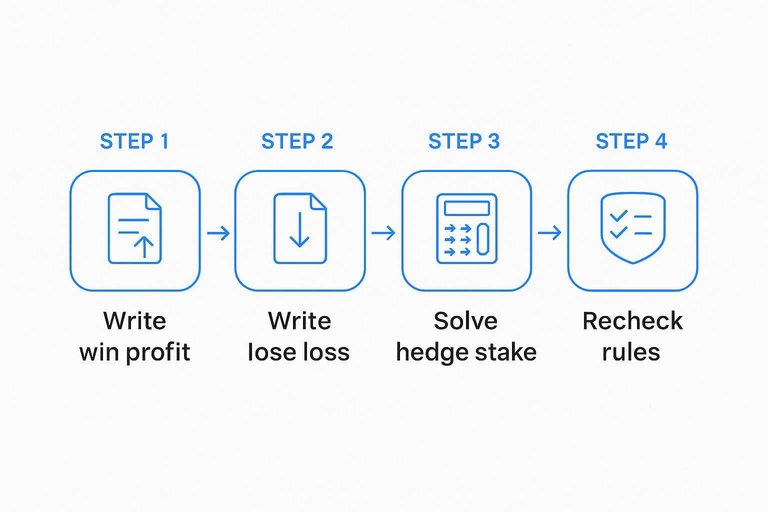
- Write your current position’s profit if it wins.
- Write your current position’s loss if it loses.
- Add a hedge bet that pays on the opposite outcome.
- Solve the hedge stake for your target: break-even, profit lock, or partial reduction.
- Recheck with fees, void rules, and stake return.
Once you can solve one hedge stake on paper, you can size any hedge in seconds.
Correlation pitfalls
Hedges fail when your “opposite” bet is secretly linked to your first bet.
- Backing the same team across multiple markets
- Ignoring group results that shape knockout paths
- Hedging an outright with a match that boosts its probability
- Stacking props that depend on the same minutes played
- Treating “draw no bet” as uncorrelated
If you see shared drivers, you’re not hedging risk. You’re doubling it.
Decision winner
Match bets usually give tighter sizing because they collapse the hedge into one opposing state and one price. Outrights can be hedged, but you’re often managing a portfolio of opponents, timing, and bracket risk.
If you want precision, pick the market with fewer states to control.
Live Betting vs Pre-Match
Pre-match hedging is calmer and cleaner, but it assumes the game behaves. In-play hedging trades certainty for control, because new information hits every minute. Match bets dominate when the game state changes your probabilities fast, while outrights still matter when your portfolio risk is tournament-wide.
In-play hedging edge
Live odds move with every goal, card, and tactical swing, so you can hedge when the market reprices reality. That reprice is often sharper in match markets than in winner outrights, because the event is immediate. The catch is execution: you must get matched at the price you expect, fast.
Execution risks
In-play hedging punishes sloppy process because the market keeps moving.
- Suspensions from goals, cards, VAR checks
- Stream delay versus live action
- Stale odds during fast moves
- Max-stake or liability limits
- Emotional clicks under pressure
If you cannot trust your feed and your rules, hedge pre-match instead. For examples of how books handle in-play execution friction, review typical delay/rejection and significant-event rules.
Practical in-play plan
You need rules that survive chaos.
- Predefine triggers like “goal against” or “red card” actions.
- Set stake caps per hedge and per match.
- Use exchange limit orders, not market orders.
- Log price, time, and reason for each hedge.
- Review logs after the match, not during.
Your edge is consistency, not prediction.
Winner by scenario
Different shocks price faster in different markets.
| Scenario | Better market | Why it wins | Hedge focus |
|---|---|---|---|
| Early goal | Match bets | Immediate repricing | Protect downside |
| Underdog lead | Match bets | Volatility spikes | Lock partial profit |
| Injury news | Outrights | Wider impact | Reduce exposure |
| Lineup surprise | Match bets | Fast correction | Rebalance stake |
Use match markets for game-state shocks, and outrights for tournament-level shocks.
Costs and Friction
All-in hedging is rarely “free.” Your real cost is the spread, the limits, and the rules that block clean execution.
| Friction point | Winner Team market | Match Bets market | Hedging impact |
|---|---|---|---|
| Typical spreads | Wider, multi-week | Tighter, game-day | Match bets leak less |
| Liquidity depth | Uneven by team | Deeper per match | Easier to size |
| Limits & throttles | More restrictions | Fewer restrictions | Fewer failed hedges |
| Settlement timing | End of tournament | End of match | Faster feedback loop |
| Rule edge cases | More clauses | Fewer clauses | Fewer surprises |
If you want the lower-friction hedge under typical conditions, match bets usually win on execution alone.
Choose Your Hedge Market with One Clear Rule
If your priority is precision—clear sizing, quick settlement, and the ability to adjust after new information—match bets are usually the cleaner hedging vehicle. If your priority is protecting a long-running outright position and you can tolerate slow repricing, limited liquidity, and more path-dependent outcomes, winner-team markets can still hedge well when you treat them as exposure management, not fine-tuning. Pick one primary market for your hedge plan, then price-shop across books/exchanges and predefine your triggers (odds moves, lineup news, or bracket shifts) so you don’t improvise under pressure.
Frequently Asked Questions
- Is a “world cup winner team” bet the same as “to lift the trophy” or “outright winner” markets?
- Yes—those labels usually refer to the same outright market: the team that wins the tournament. Always confirm the settlement rule (champion after extra time/penalties) in the sportsbook or exchange market details.
- Can I hedge a world cup winner team bet without using a betting exchange?
- Yes, but it’s usually less precise because you’re limited to the sportsbook’s available markets and odds. The most common approach is to use match-level markets (moneyline/draw no bet/advance) on the remaining games to offset your outright exposure.
- How do I track my exposure and hedge math on a world cup winner team outright across multiple matches?
- Maintain a simple spreadsheet with your outright stake/odds and a running “net profit if they win vs if they don’t” line, then size each new hedge bet to move those outcomes toward your target. Use the current odds for the team’s next match (or “to qualify/advance” market) as the hedge input.
- What’s the best way to hedge a world cup winner team bet when my team reaches the knockout rounds?
- Hedging with “to qualify/advance” (rather than 90-minute match result) often matches the outright’s settlement condition more closely. If that market isn’t available, use a combination of match result and “lift the trophy”/opponent outrights to reduce the number of outcomes you need to manage.
- Does cash out work as a hedge for a world cup winner team bet, and when should I avoid it?
- Cash out is a hedge substitute because it closes or reduces the position instantly, but the price can include extra margin and may be worse during volatile moments. Avoid relying on it when you need tight pricing—compare it to placing your own opposing bets (or laying on an exchange) first.